Showing posts with label My posts/articles. Show all posts

Tuesday, 24 February 2015

The Exodus as a symbol of our spiritual life (a summary)

The People of Israel are in Egypt, slaves of Pharaoh. Moses leads them out of Egypt through the waters of the Red Sea, where Pharaoh and his soldiers are drowned, into the desert with the promise of one day reaching the Holy Land. They wander in the desert for 40 years, guided by the Pillar of Fire and the Commandments, and sustained by Manna from heaven. Some longed to return to Egypt, preferring the relative comfort of Egyptian slavery to the hardships of freedom in the desert. The prophet Jesus (Joshua) finally leads those who have remained faithful into the Promised Land.


We are in the world, slaves to the Devil. We are led out of this slavery through the waters of baptism, where the Devil and his demons lose their power over us. We thereby enter the battleground of faith, the Church militant, guided by the Spirit of God and Holy Tradition, and receiving divine sustenance from the Eucharist. Some return to the ways of the world, preferring the comfort of sin to the hardship of the Cross. At the end of one’s earthly life, those who have remained faithful attain the Heavenly Jerusalem, the presence of Jesus.


The End

Tuesday, 30 December 2014

Do we always honour God by following His commandments?

Yesterday, someone came into the church and asked me where she might be able to buy unleavened bread. I told her she’d be better off trying a Jewish shop if she was on the lookout for matzos, but wondered why she was so keen to get her hand on some.  She replied: “I was reading the Old Testament and saw that God wants us to eat unleavened bread. If God says something, we should do it. If I can praise God by eating a different type of bread, isn’t it a good thing to do?”

This is a good example of what happens when someone just picks up a Bible and reads a random verse or chapter without any consideration for the context. However, the relationship between Christian life and the Old Testament Law is something many seem to struggle with. Christians are often called hypocrites or accused of cherry-picking by secularists because they consider homosexual or pre-marital relations a sin while they happily chow down seafood, also called abominable in the book of Leviticus. This is not helped by certain fundamentalist pastors (mainly in the U.S., but not only) who call for homosexuals to be put to death as a Biblical answer to the AIDS epidemic (as featured in the news this month). The latter example is extreme and limited (not to mention silly), but the underlying problem – not understanding the proper Christian attitude to the Law of Moses – is common. That it should be so is unfortunate since it is a dominant theme running through almost all the books of the New Testament, and so one has to conclude that these people have only read these superficially, if at all.

St. Paul is very clear: “the law was our guardian [the Greek word here is probably better translated “tutor” or “nanny”] until Christ came, in order that we might be justified by faith. But now that faith has come, we are no longer under a guardian, for in Christ Jesus you are all sons of God, through faith” (Gal. 3:24-25). The Law is not simply disregarded, but was given to a specific people for a specific reason and until a specific time. Truth will always be truth, falsehood will always be falsehood. But a precept applicable to one time and place will not necessarily be applicable in another. A parent who forbids his underage child to consume alcohol has not changed his mind if he allows the same child to drink after he turns 18. The rule has not been ignored, but has been fulfilled. Hence Christ says, “Think not that I am come to destroy the law, or the prophets: I am not come to destroy, but to fulfil” (Matt. 5:17).

Thus, in order to answer the original question, “If God says something, shouldn’t we do it to honour Him?” one must first ask “Why did He say it? When? and, To whom?”

If your spouse or a dear friend has to go away for several months and they give you a photograph to keep with you until they return, you can honour them in their absence by keeping the picture in a particular place, looking at it, perhaps even kissing or talking to it. However, if when they return you pay no attention to them, but instead continue staring at the picture, this former sign of affection becomes a dishonour.

An example: Before the coming of Christ, God was honoured by the keeping of the Passover and the keeping alive of the memory and symbols of things to come. Now that Christ has come, God is honoured by us keeping the Christian Passover (Pascha), where we celebrate the realisation of these symbols. If we continue to celebrate the Israelites’ redemption from Pharaoh and slavery, but not our deliverance from the devil and sin; if we celebrate the lamb’s blood smeared over the doors, but not the Blood of the Lamb poured out for us and for many for the forgiveness of sins; if we celebrate the Israelites being led to the Holy Land by Jesus (Joshua) of Navi, but not Jesus the Son of God opening up to us the doors of Paradise, then we do not honour God by our observance.
There is much more to say on the subject, but I felt like sharing this little incident since it is a question that seems to trouble many sincere and devoted believers. In the end our visitor decided not to continue on her matzo-hunt, but instead to join us for a service in the near future.

Monday, 14 July 2014

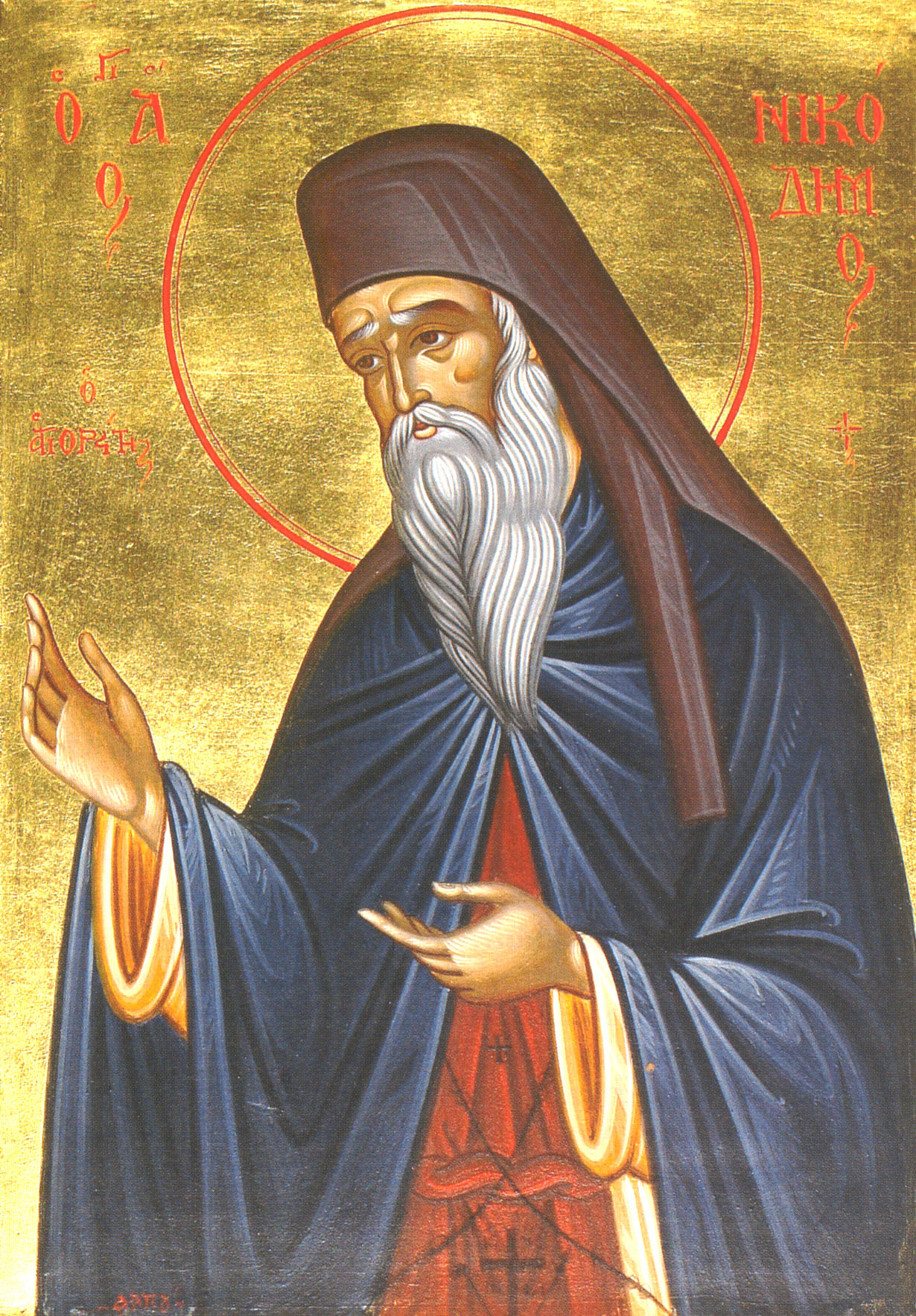
St. Nikodemos the Hagiorite and a life of purpose

Today we celebrated the memory of one of my favourite Fathers of the Church, St. Nicodemos the Hagiorite. His written work, which is extensive, is characterised by a wonderful talent for synthesis. When reading his works, one hears not only the voice of St. Nicodemos himself, but that of St. John Chrysostom, Basil the Great, Gregory the Theologian, Nilus, and other pillars of the faith. The Hagiorite was blessed with an extraordinary memory, and quotes at length from these texts which he knew by heart, word-for-word. His works are therefore a great entry point for anyone wishing to familiarise themselves with the wider patristic corpus.

What I particularly love about St. Nicodemos is his insistence that everything be done with purpose. The Kollyvades movement, for example, of which he was a part, opposed the practice of conducting memorial services on Sundays, the day of the Resurrection, instead of the Sabbath (Saturday), when we remember those who have gone to their rest in the Lord, and of course the Lord’s own burial and descent into Hades. For St. Nicodemos, the moving of memorials from Saturday to Sunday undermined the theological significance of both those days, as well as the memorial service itself. Not only this, but the habit of moving things to the nearest Sunday so as to accommodate those who do not attend church during the week risks making Christianity a Sunday-only religion, rather than an integral part of ones daily life. Indeed, in his Christian Morality, the saint laments how laypeople in his day only attended church twice or thrice a week, rather than twice a day (for Vespers and Matins) as had always been the norm for pious Christians since the early Church.

Yet this tendency is also what makes St. Nicodemos, like many of the other Fathers, unpalatable for some modern readers. They find him overly harsh for calling condemnable everyday things that most of us consider perfectly harmless. He is dismissed as a fanatic, a monastic zealot, not suitable for lay readers. Yet his apparent fanaticism stems precisely from this insistence that all we do must have purpose and meaning. It is the very antithesis of the pharisaism and legalism of which he, and those like him, are often accused. A Pharisee is one who does things for their own sake, without care for or to the detriment of their actual purpose or meaning. St. Nicodemos strict approach, however, stems from his desire to avoid precisely such an empty and meaningless observance of ritual and rules. For him, conducting memorials on Sunday for the sake of convenience, for example, is a pharisaic act, reducing the memorial to an empty ritual by removing it from its theological context.

As men of constant prayer, the Church Fathers made no real distinction between the religious and secular. God must stand at the centre of all aspects of life. For this reason, St. Nicodemos’ insistence on purpose extends beyond what we normally think of as exclusively religious. He condemns, for example, the playing of board games, secular music and dancing. He does this not because they are in and of themselves wicked things, but because they are distractions and a waste of time, time given to us for repentance, for drawing nearer to God, time which we will never be able to regain once lost, precious hours, minutes and seconds those who died without repentance would give anything to get back. Had he lived today, I am confident the longest chapters in Christian Morality would have dealt with all the time wasted on YouTube and social media. If something cannot bring us closer to God, then it is void of purpose, and if it is void of purpose it is ultimately destructive, no matter how benign a thing it may seem to be in and of itself. If we are offended by such admonitions, it is ultimately because we view the call to repentance, the call to a closer relationship with Christ, as something negative. Rather than seeing this as a positive call to lay aside our earthly cares to make room for something deeper and better, to love the Lord our God with all our heart, all our soul, all our strength and all our mind, we staunchly cling to the various comforts and addictions from which we derive temporal pleasure, and interpret any attempt to call us out of our complacency as an unwarranted attack on our person.

The extent to which we apply his words to our own lives is naturally a matter of personal discretion and requires the discernment of one’s spiritual father. As with any spiritual text, including the Divine Scriptures, caution is needed, as many fall prey to “temptations from the right”, attempting to do too much too soon, burning out and falling into despair or faithlessness as a result. Nonetheless, when we analyse our reaction to his words, we see that they become a mirror in which we can catch a glimpse of our true spiritual condition. When the saint calls us to this higher, more purposeful way of life, it is one thing to answer “I’m not ready” or “I’m too weak” in honest humility and quite another to proudly dismiss the call as foolishness or backward extremism. We seem to forget that it was not a zealot monk, but the Lord Himself, who said, “If thou wouldest be perfect, go, sell that which thou hast, and give to the poor.”

May the prayers and wisdom of our holy father Nicodemos help us lead a life of greater purpose and to meet the call to turn to Christ with enthusiasm and joy, not prideful resistance.

Wednesday, 11 December 2013

We offer Thee incense...?

This post is more of an open question which will probably interest very few people, and to which I do not know the answer. Among Eastern Orthodox, the use of incense in personal prayer at home is a very common practice and, in my over-keen teen-convert days, my room often looked like something out of a cypress-scented Cheech and Chong movie. As such, I was quite surprised to discover that in Cyprus – where, despite centuries of foreign occupation and plenty of Western influence, many ancient traditions are preserved which have been lost elsewhere – the use of incense in the home is a novel practice, not known to the older generations. Dried olive leaves are used, but incense is strictly for church.

The practice is also largely unknown among laypeople in the Oriental Orthodox churches (another repository of ancient liturgical traditions now lost to us). While in the Eastern Orthodox (Byzantine) tradition, only a priest can bless the incense, the Oriental churches also maintain the older tradition whereby only the priest may apply incense to the thurible. The word “thurible” itself derives, via French and Latin, from the Greek “θύειν”, meaning “to sacrifice.” Someone with better knowledge of Greek than I will have to confirm whether the Greek “θυμίαμα” (incense) derives from the same root. However, when the priest blesses the incense, the notion of sacrifice is clear: “We offer Thee incense, O Christ our God, for a savour of spiritual fragrance. Having accepted it at Thy heavenly altar, send down upon us in return the grace of Thine all-holy Spirit.” The Liturgy of St. James, which contains several longer prayers for the blessing of incense, brings this out even more clearly. To sacrifice, as we know, is the prerogative of the priesthood. Laypeople may bring offerings – bread, wine, wheat, oil, incense – but it is the priest who blesses and the priest who offers.

The incense used in private devotion is not blessed, so it is not, strictly speaking, a case of laypeople taking upon themselves the roles which belong exclusively to the priesthood, but in that case, is it an “offering”? If so, in what sense? Perhaps in the same way that the oil in ones votive lamp, lit while at prayer (or constantly), is an offering, but the role of incense in worship is something much more substantial than a mere sign of devotion, and certainly more than a religious mood-setter or liturgical air freshener. It is an act of sacrifice.

This is not a question about “right or wrong”, but I’m hoping someone can satisfy my nerdy curiosity as to when the use of incense among the laity became widespread and normative, and whether it arose as something completely unrelated to the use of incense in church (and later became identified with it) or if it was a borrowing (perhaps inappropriately) by the laity of a priestly liturgical function. In the latter case, might it stem from the now common malpractice, particularly in the Greek tradition, of allowing altar-servers (or sometimes any random man in the congregation) to cense during the Great Entrance or when being handed the censer by a priest or deacon?[1]

Thoughts anyone?


[1] Strictly speaking, use of the censer is not permitted to anyone below the rank of deacon, nor mere handling of the censer by anyone below the rank of subdeacon.

Wednesday, 19 June 2013

Anathema!

This Sunday we celebrated the holy Fathers of the First Ecumenical Council in Nicea, which championed the Christian doctrine of God as Trinity against the Arian blasphemy that Christ was born of the Father in time, and therefore a finite creature, and declared that anyone who held to Arius’ heresy were anathema.

Particularly in recent times, the term anathema has itself become anathema to most people. The list of anathemas appointed to be read on the Sunday of Orthodoxy in Lent is almost always omitted, and the existence of such a rubric is a source of embarrassment to many. Not only do people feel uncomfortable hearing anathemas pronounced against teachings which, in a pluralistic society, might be held by co-workers, friends and even family, but there is also a sense that it goes against the very spirit of Christianity. After all, Christ said “bless those who curse you,” not “curse those who disagree with you.”

The practice is, of course, biblical, rooted in the words of St. Paul the Apostle: “If anyone has no love for the Lord, let him be anathema” (1 Cor. 16:22); “But even if we or an angel from heaven should preach to you a gospel contrary to the one we preached to you, let him be anathema” (Gal. 1:8). Thus, by declaring someone to be anathema, the Holy Fathers are simply making apparent the fact that their gospel is a foreign one.

But even if we can justify it by appealing to the Apostolic Writings, how should we understand it? When we look up the word in normal English dictionaries, it is no wonder it sits so uncomfortably with people. Common definitions include “a person or thing detested or loathed,” “a person or thing accursed or consigned to damnation,” “a curse,” and so on. Likewise, most English translations of the Scripture tend to render the word “accursed.”

However, when we look at the actual etymology of the word, we see that it literally means “a thing devoted,”  “set up” – i.e. to God (or the gods in Ancient Greek usage). In the Old Testament, the Greek word ‘anathema’ is used to translate the Hebrew word ‘herem,’ which comes from the verb to consecrate or devote. Once something was “so devoted to the Lord [it] could not be redeemed (Num. 18:14; Lev. 27:28-29); and hence the idea of exterminating [also] connected with the word” (Easton’s 1897 Bible Dictionary). The Encyclopedia Britannica (2008) says “(from Greek anatithenai: ‘to set up,’ or ‘to dedicate’), in the Old Testament, a creature or object set apart for sacrificial offering. Its return to profane use was strictly banned.”

St. Paul tells us that “As for a heretical person, after warning him once and then twice, have nothing more to do with him, knowing that such a person is warped and sinful; he is self-judged” (Titus 3:10-11). It was only after ignoring the repeated admonitions of Orthodox bishops and persisting in their heresy that heretics were declared anathema by the Church. Once the Church had done all it possibly could to bring them to repentance, the only thing left to do was to turn them over to God, to end their dispute with them and leave them in His hands. Thus, when the Church declares someone anathema, it is not placing a curse upon them, declaring them detestable and sentencing them to damnation. Rather, it is a way of saying, “there’s nothing more we can do for this person, we entrust him – we set him up - to God.” To entrust someone to the God of love is not an act of hatred, but of mercy. 

Saturday, 11 May 2013

Pharisaism


In the last issue of Orthodox Tradition, one of the few publications I subscribe to, there was an interesting entry on ‘Orthopraxis’ by Archbishop Chrysostomos of Etna, a person always worth reading whatever the topic. Though not quoted there, the gist of what he writes can be summed up by the famous dictum of St. Maximos the Confessor – “Theology without praxis is the theology of demons” - “It means nothing to believe correctly if that belief has no consequences in action and for the way that we live.” He identifies Orthopraxis with such “internal” matters as “repentance for our failings, the hard rule of forgiving others as we find fault with ourselves” but also “external” things, “how we speak, walk, dress and groom ourselves, how we relate to others, and how we eat (not to mention, of course, how we worship).” When it comes to these external matters, warnings or accusations of ‘Pharisaism’ invariably come up, and perhaps rightly so, since Christ is quite clear as to what kind of future life shall await us if we do not heed the warnings He gave the Pharisees. Indeed, we shall be judged more severely, having been called to a higher standard. That being said, however, I feel the term is often misunderstood, misused, and at times even used as a stick to beat others over the head with (or should I say a plank, which, once removed from the eye, is used to punish those with motes in theirs).

So what is Pharisaism? Doctrinally speaking, it meant belief in the resurrection of the dead, for which reason St. Paul exclaimed “Brothers, I am a Pharisee, a son of Pharisees” (Acts 23:6). This is obviously not what those who use it today have in mind. Rather, it refers to the admonitions of Christ, particularly those in the 23rd chapter of Matthew’s Gospel. They are condemned for keeping the minutiae of the Law, but neglecting its true meaning, for taking care to appear outwardly righteous while neglecting to purify their hearts, for performing prayers and good deeds out of love of self rather than of God and their neighbour, of honouring the past prophets while cursing those who in their own day followed their example. In short, for their hypocrisy and pride. Never does Christ suggest that observance of externals was wrong in and of itself. Only when they are done for the wrong reasons, or at the expense of more important things do they become a problem: “Woe to you, scribes and Pharisees, hypocrites! For you tithe mint and dill and cumin, and have neglected the weightier matters of the law: justice and mercy and faithfulness. These you ought to have done, without neglecting the others” (Matt. 23:23).

Such hypocrisy is something we must always be on guard against, and something most probably struggle with at times (I certainly do). This I don’t dispute. Yet there are those who, presumably able to discern the hearts of men, disparage all forms of Orthopraxis as Pharisaism, as if all who fast regularly or strictly, who dress modestly, who don’t participate in certain social activities, are somehow doing it out of a self-righteous display or in judgment of those who don't, rather than out of a humble desire to improve their lives, grow closer to God, and mind their own business in the process. I have on numerous occasions seen people, knowing full well a person was observing Lent, proceed to offer them food they knew they wouldn’t wish to eat. When the person declined with a polite “no thanks, I’m not hungry”, they were met with hostility and accusations of self-righteousness. The prayer of the Publican is no longer “God, be merciful to me, a sinner” (Lk. 18), but “God, I thank you that I am not like the Pharisee”. In other words, the spirit of Pharisaism is not found only in the observance of externals, nor does the observance of externals necessitate Pharisaism. Indeed, the very purpose of external observances is to “infuse everyday acts with spiritual significance” and, when properly understood, serves to aid in the purification of the soul and to cultivate humility, repentance, love for God and neighbour, which will in turn be reflected in one’s behaviour. 

There seems also to be an artificial separation between “good behaviour” and “religious behaviour”. Social work is good, everyone likes that, but prayer and fasting is for the Pharisee. Yet Christ said exactly the same about giving alms as He did about prayer and fasting – do not do it to be seen by men. The call to do things without pride and hypocrisy should not be confused with a call to stop doing them altogether. Praying for those who hate you is Orthopraxis, so is feeding the hungry, clothing the naked, visiting those in prison, as well as lesser matters like dressing modestly, observing the fasts as far as our strength allows, keeping a rule of prayer, and attending church. Perhaps it’s the name that throws people. Much in the same way as books on Orthodoxy are not actually books on Orthodoxy (i.e. Christianity), but only on those aspects of Orthodoxy which differ from Protestantism or Catholicism (and often just the external ones), so perhaps Orthopraxy is not understood as life according to the Gospel, but the observance of practices at odds with those of heterodox Christians (fasting and prostrations).

The Pharisee can just as easily be the one who eats as it can be the one who abstains (cf. Rom 14:3). Let’s therefore not allow "Pharisaism" to undermine the importance of Orthopraxis to our Christian life and relationship with Christ - either to justify our own laxity or weakness, or to undermine the struggles of others - all the while taking care not to think ourselves righteous or judge those whose conduct is different from our own. 

Thursday, 28 March 2013

The Bible and racism

Non-believers who have never read the Bible seem to have a habit of making long lists of what kind of horrible things it contains. One thing that almost always makes the list is racism. But what does the Bible actually say about racism?
And Mariam and Aaron spoke against Moses on account of the Ethiopian woman whom Moses had taken, because he had taken an Ethiopian woman. And they said, "The Lord has not spoken only to Moses, has he? Did he not also speak to us?" And the Lord listened. And the man Moses was very meek, more than all the people who were upon the earth. And the Lord said at once to Moses and Mariam and Aaron, "Come out, you three, to the tent of witness." And the three came out to the tent of witness. And the Lord descended in a pillar of cloud and stood at the door of the tent of witness. And Aaron and Mariam were called, and they both came out. And he said to them, "Hear my words: If there is a prophet of you for the Lord, in a vision I will be known to him, and in sleep I will speak to him. Not so my attendant Moses; in my whole house he is faithful. Mouth to mouth I will speak to him, in visible form and not through riddles. And he has seen the glory of the Lord. And why were you not afraid to speak against my attendant Moses?" And the anger of the Lord's wrath was against them, and he departed. And the cloud withdrew from the tent, and behold, Mariam was leprous like snow, and Aaron looked upon Mariam, and look, she was leprous. And Aaron said to Moses, "I beg you, Sir, do not lay extra sin upon us, because we were ignorant in that we sinned. Do not let her be like unto death, like a miscarriage coming out of a mother's womb, and it devours half her flesh." And Moses cried out to the Lord, saying, "O God, I beg you, heal her!" And the Lord said to Moses, "If her father when spitting had spat in her face, would she not be put to shame for seven days? Let her be separated for seven days outside the camp, and afterwards she shall enter." And Mariam was kept apart outside the camp for seven days, and the people did not set out until Mariam was cleansed. [Numbers 12]
In other words, marrying a person of a different colour or race is perfectly fine, speaking against those who do is ignorance and sin, and racists are deserving of leprosy and exclusion from the rest of society. Not sure it could be much clearer than that.

Thursday, 7 March 2013

Seven times a day do I praise Thee - The Liturgical Cycle made simple(r)

Seven times a day do I praise Thee because of Thy righteous judgments - Ps. 118:164

If you have ever brought a prayer book with you to a Matins/Orthros or Vesper service, you will probably have noticed that following along for more than a few minutes is a near impossibility. Even the most static of services (the Divine Liturgy and the Hours) will have components that vary from day to day, from season to season, and which can throw you off if you're following along in a book. A detailed explanation of the Typikon would require a whole book, and such books have now begun appearing in English. I have yet to read them, but The Typikon Decoded and Protheoria of the Biolakes Typikon look like very good sources for those wishing to get more information. In this post, I simply wish to acquaint the reader with the different daily services in their standard form, their purpose and timing, the main liturgical cycles (daily, weekly, monthly), and the books containing them.

Slavonic Chasoslov/Horologion


An outline of the daily services

Vespers (The Eleventh Hour)
Following Hebrew reckoning - "And there was evening and there was morning, the first day" (Gen. 1) - Vespers, prayed at sunset, is the first service of the liturgical day. Accordingly, it opens with Psalm 103, which praises God as creator. It then continues with the raising of incense and chanting of Psalms 140 (Let my prayer be counted as incense before you, and the lifting up of my hands as the evening sacrifice), 141, 128, and 116. The final verses of the Psalms are interspersed with the hymns of the day, taken from the Paraklitiki and Menaion (see below). As the sun sets, we sing the hymn 'O Joyful Light' (Fos Hilaron), remembering that Christ is the true Sun of Righteousness. The service then continues with further evening prayers, hymns, and the Song of Symeon (Now you let your servant depart in peace).

Compline (The Twelfth Hour)
The Greek word for Compline is 'Apodeipnon', which literally means "after dinner". In monasteries, monks will go to the refectory for dinner after Vespers, and then immediately return to church for the reading of Compline before retiring for the evening. Compline is therefore read in the evening before sleep. Being the last service of the waking day, it is penitential in nature. We ask God for forgiveness for our offences (for we might not wake up the next day!), freedom from our spiritual foes, for a peaceful rest free from disturbances, and that we might be granted a new day. We also invoke the help and intercessions of the Mother of God particularly at this time, and it is customary to read the Akathist Hymn when no other canon is appointed.

The full Compline service (Great Compline) is only read during Great Lent. The rest of the year, we read a shorter form (Small Compline).

The Midnight Hour
As the name suggests, this service should begin in the middle of the night - somewhere between 1-4am being the norm in most monasteries. Most laypeople will simply pray it when waking up, the 'Morning Prayers' found in most Orthodox prayer books being an abbreviated form of the Midnight Office. Being the first prayer of the waking day, we begin with prayers of thanksgiving for having risen from sleep and having been granted a new day of life. The essential theme of the rest of the service is wakefulness and anticipation of the second coming of Christ, summed up by the hymn 'Behold, the bridegroom comes at midnight, and blessed is the servant whom He shall find watching' - "At midnight there was a cry, ‘Here is the bridegroom! Come out to meet him" (Mt. 25:6). 

Matins/Orthros
Having looked to the second coming in the Midnight Office, Orthros, which immediately follows it, opens with the reading of the Six Psalms (3,37,62,87,102,142) which call to mind the Day of Judgement. Following this are readings from the Psalter, the chanting of canons (based on the 9 Biblical Odes, which are now only sung during Lent) in honour of the feast or saint of the day, Psalms of praise (148-150), and a final Doxology. Orthros should be held early in the morning, before dawn, the time at which Christ rose from the dead, which is why its a theme probably more prominent at Orthros than any other service - on Sundays the Resurrection Gospel is read and the Troparia of the Resurrection are sung.

The First Hour
The First Hour immediately follows the end of Matins, at sunrise. The Psalms all make reference to the morning, while the concluding prayer, much like the Vesperal hymn, invokes "Christ the true Light that enlighteneth and sanctified every man that comes into the world". Although the practical reasons are obvious, it's a shame that services are so rarely said at their appropriate time outside of monasteries, since the purpose of these prayers is to connect the passing of earthly time and the movement of the heavenly bodies with the theological realities they symbolise.

The Third Hour
We are told in the book of Acts that it was at the third hour (i.e. 9am) that the Holy Spirit descended on the Apostles on the day of Pentecost (Acts 2). This is therefore the central theme of this hour of prayer. This is why we read Psalm 50, for example, and pray "Create in me a clean heart, O God; and renew a right spirit within me. Cast me not away from thy presence; and take not thy holy spirit from me". The third hour was also the time of our Lord's crucifixion, as we are told in Mark 15:25.

The Sixth Hour
We are told in the Gospels that, as the Lord was hanging on the Cross, at the sixth hour (noon) there was darkness over all the land until the ninth (Mt. 27:45, Mk. 15:33, Lk. 23:44). For this reason we commemorate the Lord's crucifixion at this hour. 

The Typika
The Typika contains the Psalms and readings of the Divine Liturgy and is read when there is no Liturgy. It, or the Liturgy, is normally followed by the morning meal.

The Ninth Hour
It was at the ninth hour (3pm) that Christ cried out on the Cross and died in the flesh. This is therefore the theme of the ninth hour prayers. We are also told in the book of Acts that "Peter and John went up together into the temple at the hour of prayer, being the ninth hour" (3:1). Furthermore, in Acts 10:30, Cornelius attests to the practice of fasting until the ninth hour. On days of strict fasting, we should therefore abstain from food and drink until the ninth hour (although this is rarely observed outside monasteries), connecting our ascetic labours to the Lord's passion. Since it is common practice to pray the ninth hour immediately before Vespers, this generally means fasting until the evening meal mentioned above. This is also why, during Lent, the service of the Typika, which is connected with mealtime, is held after the 9th hour rather than the 6th.


We can see all the hours of prayer mentioned in the parable of the vineyard and the labourers in Matthew 20, where the owner goes out, first in the early morning, then at the third hour, then the sixth and ninth, and finally at the eleventh. Thus, through the daily cycle of prayers, we rush to accept the Lord's calling at each possible moment.


The main liturgical books

The Horologion (Book of Hours) - the daily cycle
This is the primary prayer book of the Church and contains the fixed parts of all the daily services mentioned above. It sometimes called the 'Annotated Psalter' since the fixed parts of the services consist first and foremost of Psalms. You should think of Horologion as the skeletal structure or foundation of the liturgical cycle, on which the other books simply elaborate and adorn. The Horologion normally also includes Apolytikia and Kontakia for every day of the year, meaning that it contains everything you need for all services other than Vespers, Matins and the Sunday Midnight Office.

The Paraklitiki/Octoechos (Book of Eight Tones) - the weekly cycle
This book contains hymns for each day of the week, all of which have different themes. Sunday is, of course, the day of the Resurrection of Christ; Monday is dedicated to the holy angels; Tuesday to St. John the Baptist; Wednesday and Friday to the Cross; Thursday to the Holy Apostles and St. Nicholas; and Saturday, the day of rest, to the memory of the dead who have gone to their rest before us. Thus, if you attend Vespers on a normal Saturday evening (i.e. the beginning of Sunday liturgically) and hear hymns mentioning the resurrection, you will know they come from the Paraklitiki. 

Furthermore, the Byzantine musical system makes use of 8 different modes - that is 8 different scales or tones according to which the hymns are sung. A different mode is used each week: we go from 1-8 and then start at one again. Accordingly, the Paraklitiki has a different set of hymns for each of the 8 tones. In other words, there are 8 sets of Sunday hymns, 8 sets of Monday hymns, 8 sets of Tuesday hymns, etc. So, let's say today is Thursday in Tone 6 (properly called Plagal of the Second mode), you will sing the fixed hymns of the daily services from the Horologion in Tone 6, and then sing the Thursday hymns from the Paraklitiki in the same tone.

The Menaion (Book of Months) - the monthly cycle
The Menaion, which comes in 12 volumes - one for each month - contains the hymns and readings for the feast or saint of each day of the month. Since Christmas, for example, always falls on December 25th, you will find the relevant hymns in the December volume of the Menaion. Since having 8 sets of hymns for each of the 365 days of the year would make things rather difficult, there is only one tone appointed for each hymn, and so we simply sing the hymns of the Menaion in their tones, regardless of which tone is appointed for that week. So while we might sing the stuff from the Octoechos and Paraklitiki in Tone 2, let's say, the hymns from the Menaion could be in Tone 1.

The church year, like Jewish new year, begins in the autumn. September is therefore the first volume of the Menaion, 1st Sept. being the first day of the liturgical year, and August the last. According to the Church calendar, this year (1 Sept 2012 to 31 Aug 13) is the year 7521, although that has no bearing on the services.


Confused yet?
To recap, The Horologion has stuff for each time of day (Matins, 1st Hour, Compline, etc.), the Paraklitiki has stuff for each day of the week (Monday, Tuesday, Wednesday, etc.) and in each tone, while the Menaion has stuff for each day of the month (1st Jan, 7th March, 15th July, etc.).

The Triodion - Lent
The season of the Triodion lasts from the Sunday of the Publican and the Pharisee, two weeks before the start of Lent, until the end of Holy Week, so if you're wondering where to find all of the beautiful hymns you hear during the Bridegroom Services, for example, you'll find them here. Essentially, the Triodion replaces the Paraklitiki (except on Sundays, when the hymns of the Resurrection are also sung), and is used in the same manner, although the structure of the services change a little during Lent. I will therefore not make mention of it below when I outline the structure of each service.

The Pentekostarion - Paschaltide
The season Pentekostarion begins with the Resurrection service on Easter Sunday and lasts until the Sunday of All Saints, two weeks after Pentecost. It is used in the same manner as the Triodion.

The Psalterion (Book of Psalms)
These are simply the 150 Psalms of David you find in any copy of the Bible, but arranged for liturgical use. The Psalms are divided into 20 kathismata, or sittings (yes, you're supposed to sit when they're being read!). Two kathismata are read at Matins, while one kathisma is read at Vespers. That way the whole Psalter is read in its entirety once a week. During Lent, this is doubled and the Psalter is read twice a week. Each kathisma is further subdivided into three stanzas, each separated by a threefold Alleluia, giving the reader a chance to breathe and briefly brings the congregation to their feet to ensure they remain attentive.

Hieratikon
This is the priest's service book, which contains things like the silent prayers and the litanies ('In peace, let us pray to the Lord', etc.), which are normally only indicated in the other service books since those are used by the Readers and Cantors who have no need of the full text of the priestly prayers.

Typikon
The Typikon is not a service book, but a user's guide or manual. Because the exact structure of services and how they're put together will vary depending on things like the rank of a feast, the Typikon is the book that gives you exact rules and guidelines as to how each service should be put together - i.e. which bits to get from which book and at what time.


Basic ordinary structure of each service
(All components are found in the Horologion unless otherwise noted)
Vespers
Introductory prayers
Psalm 103
Great Litany 
Kathisma of the day (Psalterion)
Small Litany (Hieratikon)
Psalms 140, 141, 127, 116 sung in tone of the week with verses from Paraklitiki and Menaion.
Entrance & Fos Hilaron
Prokeimenon of the day
Old Testament readings, if any (Menaion)
Litany (Hieratikon)
Evening doxology
Litany (Hieratikon)
Aposticha verses from Paraklitiki and Menaion
Song of Symeon
Trisagion Prayers
Dismissal Hymns/Apolytikia of the day (Paraklitiki and/or Menaion)
Dismissal (Hieratikon)

Small Compline
Introductory prayers
Psalms 50, 69, 142
Small Doxology
Symbol of Faith
*If desired/appointed: Akathist hymn, or canon of the day from the Menaion, or Canon of Preparation for Holy Communion*
"It is truly meet"
Trisagion
Troparia of the day
40x Kyrie eleison
Prayer of the Hours
Concluding prayers to the Virgin Mary, to Christ, and the Guardian angel
Litany
Hymn to the Virgin Mary
Dismissal (Hieratikon)

Midnight Hour - Monday to Saturday
Introductory prayers
Troparia to the Holy Trinity
Thanksgiving Prayers
Psalm 50
Psalm 118 (On Saturdays, Psalms 64-69)
Symbol of Faith
Trisagion
Troparia (Behold, the Bridegroom)
40x Kyrie eleison
Prayer of the Hours
Prayers
Psalms 120 and 133
Trisagion
Troparia
Prayer for the departed
Litany
Dismissal

Midnight Hour - Sundays
Introductory prayers
Troparia to the Holy Trinity
Thanksgiving Prayers
Psalm 50
Canon to the Holy Trinity in tone of the week from the Paraklitiki
Hymns to the Trinity
Litany
Dismissal

Orthros
Introductory prayers
Royal Psalms (19, 20) - usually omitted
Trisagion
Troparia
Litany and blessing
Six Psalms (3, 37, 62 and 87, 102, 142), while priest reads silent prayers from Hieratikon
Great Litany (Hieratikon)
"God is the Lord" with apolytikia and theotokia (Paraklitiki and/or Menaion)
Kathismata of the day (Psalterion) with Sessional Hymns after each one (Paraklitiki and/or Menaion)
Polyeleos (if there's a vigil)
Evlogitaria of the Resurrection - Sundays only
Small litany (Hieratikon)
Hypakoë
Hymns of ascent - only if there's a Gospel reading
Gospel reading - only on Sundays and certain feasts
"Let us who have beheld the Resurrection" - Sundays only
Psalm 50
"Save, O God, Thy people" (Hieratikon)
Odes 1-3 of the canon (Paraklitiki and/or Menaion)
Small Litany (Hieratikon)
Sessional hymn (Menaion)
Odes 4-6 of the canon (Paraklitiki and/or Menaion)
Small Litany (Hieratikon)
Kontakion, Oikos, and reading from the Synaxarion of the day (Menaion)
Odes 7-8 of the canon (Paraklitiki and/or Menaion)
Magnificat
Ode 9 of the canon (Paraklitiki and/or Menaion)
"It is truly meet"
Small Litany (Hieratikon)
Exapostilarion (Menaion)
Psalms of praise (148-150) chanted in the tone of the week with verses from Paraklitiki and Menaion.
Doxology (Great or Small depending on day or rank of feast)
Litany (Hieratikon)
Aposticha verses, if appointed (Paraklitiki)
Trisagion
Dismissal hymns and Theotokion of the day (Paraklitiki and/or Menaion)
Dismissal (Hieratikon)

First Hour
Introductory Prayers
Psalms 5, 89, 100
Apolytikion of the day 
Theotokion of the hour
Psalm verses (118:133-5, 70:8)
Trisagion
Kontakion of the day
40x Kyrie eleison
Prayer of the Hours
Concluding prayer
Hymn to the Virgin Mary
Dismissal

Third Hour
Introductory Prayers
Psalms 16, 24, 50
Apolytikion of the day 
Theotokion of the hour
Psalm verses (67:20-21)
Trisagion
Kontakion of the day
40x Kyrie eleison
Prayer of the Hours
Concluding prayer
Dismissal

Sixth Hour
Introductory Prayers
Psalms 53, 54. 90
Apolytikion of the day 
Theotokion of the hour
Psalm verses (78:8-9)
Trisagion
Kontakion of the day
40x Kyrie eleison
Prayer of the Hours
Concluding prayer
Dismissal

Typika
Psalms 102, 145
"Only-begotten Son" (O Monogenis)
Beatitudes
Epistle and Gospel readings of the day
Troparia
Symbol of Faith
Prayer of forgiveness
Lord's Prayer
Kontakia of the day (Menaion)
40x Kyrie eleison
Blessed be the name of the Lord
Psalm 33
Dismissal (Hieratikon)

Ninth Hour
Introductory Prayers
Psalms 83-85
Apolytikion of the day 
Theotokion of the hour
Psalm verses (Song of the Three Youths v.11-12)
Trisagion
Kontakion of the day
40x Kyrie eleison
Prayer of the Hours
Concluding prayer
Dismissal

Please correct me if I've made any errors or omissions 

Sunday, 3 March 2013

Diploma in Orthodox Theology

Education, education, education. Blair's mantra applies to the Church every bit as much as it does to any nation. While the lack of knowledge among many laypeople can only be ascribed to laziness or disinterest - I refuse to believe that people in this day and age wouldn't have the presence of mind to look something up on Google or Wikipedia if they actually wanted to know something - there are many who are interested, but who simply don't know where to start. Which books do I read? Which subjects should I focus on? For those who are academically minded, there are courses available, but they're often too expensive, too far away, or too time consuming for those with other commitments. 

The lack of theological education also affects the teaching of non-academic theology in the Church. I have been to churches which had Sunday school, adult catechism, Bible studies, you name it, but the people teaching them had no competence to do so. It becomes a case of the blind leading the blind, where well-intended but misinformed teachers pass on their erroneous understanding of the Faith to their well-intended but misinformed students.

I would really like to see a thorough and academic, but affordable (free!) and accessible, course in Orthodox Theology made available. One that covered such things as dogmatic theology, the philosophical foundations of Orthodox theology, Church history, patristic theology, biblical studies, and liturgics. I think a correspondence course which involved a supervised and guided programme of self-study would be the best way to achieve this. Not only would this be of great benefit to those interested in undertaking such studies, but the diploma issued would prove that the student had attained to a comprehensive knowledge of Orthodox faith and worship, and could be trusted to organise and lead various catechetical programmes in the Church. I know that a similar diploma programme in California has been accepted by a number of universities in that state, and could therefore potentially be a first step to a further education for those wishing to pursue theology at graduate level.

How would it differ from catechism?
First of all, catechism tends to be introductory. Its purpose is to teach you the essential basics of the Church's faith and worship, usually in order to prepare you for baptism. This course will be far more in-depth and academic in nature. Secondly, catechism tends to be almost 100% taught. You attend a class at regular intervals and receive all of your instruction there. You may be asked to read things at home, but normally just in order to recap or prepare for the content of the class. The diploma course would be much more like a university course in structure. Lectures would primarily serve as a way of introducing students to a particular subject and an accompanying body of literature. Actual learning would be the job of the student, who would be expected to work through a reading list, and to then produce written assignments, allowing the academic supervisor to ascertain whether they have sufficiently understood the materials in question. 

How would it differ from a university course?
Because the course would only be supervised and guided by qualified individuals, but would not involve a full-time group of lecturers or supervisor, it could be free, allowing anyone to sign up. Moreover, the structure of the course would be modular rather than based on a fixed schedule of semesters/terms. This would allow students to work at a pace that suits their circumstances. In order to facilitate this, lectures would be made available online. Students would view a lecture, acquire the relevant reading materials, and work their way through them at a suitable pace. The student would then move on to another module after supplying relevant written work, and would be awarded the Diploma upon completion of all modules. Thus, while the course would have a recommended date of completion - two years, let's say - students could finish the course in as little as one or as much as four.

Moreover, unlike any course available in secular universities, this would be a course in Orthodox theology specifically, and it would be taught from a devotional, not secular, perspective. The idea that Church history and the development of theological and liturgical expression are guided by the Holy Spirit, rather than by accidents of history, for example, is an idea we as Christians confess as truth, but which one could never express in a university essay. The desire would also be for the student to have a practical understanding of Orthodoxy. The module(s) on liturgics would therefore aim to familiarise the students with the structure of the Orthodox services, the content of the liturgical books, and the function of the 8 modal musical system.


Just some ideas. 

Thursday, 24 January 2013

The restoration of ancient liturgies

St. James the Brother of the Lord
I just returned from the celebration of the Divine Liturgy of St. Gregory the Theologian at the Church of Ss. Panteleimon and Paraskevi in Harrow, London. This is the second time this beautiful liturgy has ever been celebrated in the United Kingdom, and I would venture to guess that it has only been celebrated a handful of times elsewhere in the last millennium. In the early Church, the rites of the eastern churches were diverse and distinct - the main traditions being Alexandrian, Antiochene, Byzantine - with a number of different anaphoras being used within each local rite. Following the Islamic conquest of the Middle East and the persecution of Christians that ensued, the Orthodox patriarchates in those regions became increasingly dependent upon, and influenced by, Constantinople. Patriarch Balsamon of Antioch, for example, was a permanent resident of Constantinople and never actually set foot in his own see. By the end of the first millennium, the liturgical rite of Constantinople had come to replace the ancient rites of Antioch and Alexandria, which survived only among the non-Chalcedonian Syrian Jacobite and Coptic churches respectively, though the form of the rites  within these churches have naturally undergone significant development since the schism of 451.

The Liturgy of St. James, which had remained in continuous use only on the Greek island of Zakynthos and the holy city of Jerusalem - and then only on one day a year - is today celebrated in an increasing number of Orthodox churches. This has in turn led to an increased interest in other ancient liturgies and the Liturgy of St. Mark (the principal liturgy of the Alexandrian Rite), following the version preserved by the much loved St. Nektarios of Aegina, has now been officially approved by the Holy Synod of the ROCOR. I have also heard of recent celebrations of the liturgy of the Apostolic Constitutions. If its celebration within the Greek Orthodox Archdiocese of Thyateira and Great Britain will now continue on an annual basis, the Liturgy of St. Gregory the Theologian too is likely to be celebrated more widely within the Church.

Ss. Basil the Great, John Chrysostom and Gregory the Theologian
While I think this is certainly a positive development - it can only be a blessing for these ancient and beautiful prayers to once again resound in our churches after a thousand years of silence - it is something that raises a number of interesting questions. To what extend does restoration of a particular liturgy involve the restoration of a rite? To what extent should we attempt to recreate the rites as they were when they were in use vs. adapting them to current (i.e. Byzantine) use? The Liturgy of St. Mark, for example, is heavily Byzantinised. Rather than following an Alexandrian structure, it essentially follows the usual Byzantine structure of Great Litany, Antiphons, Small Entrance, Trisagion,  Readings, Great Entrance, Creed, etc. with the prayers of St. Mark's Liturgy slotted in to the appropriate places. The Liturgy of St. James, on the other hand - though not without the instertion of Byzantine elements - is often characterised by attempts to reconstruct ancient Jerusalem practice. The altar is moved outside of the iconostasis, the clergy face the people (a practice for which there seems to be little justification), and so on. This to me goes too far and seems needless and inappropriate. Where do we draw the line? Shall we try to reconstruct ancient chants based on the guesswork of musicologists, ancient vestments based on depictions on old icons? Moreover, many ancient texts have very limited rubrics and we're forced to fill in the gaps. The Liturgy of St. Gregory, for example, has many long and elaborate prayers, but relatively little chanting. Should these prayers simply be read or be intoned in accordance with ancient practice? If intoned, in what way? In other words, a certain degree of reconstruction is needed, and it seems better to do this through the incorporation of existing modern practice.
Liturgy of St. Gregory the Theologian celebrated in the
Church of Ss. Panteleimon and Paraskevi, Harrow, London.
Source: londinoupolis.blogspot.co.uk
Then there's the question of content. Some texts will not include things like the Symbol of Faith, since this did not become part of the Liturgy until after their compositions. But the Church did not add the Symbol of Faith to the Liturgy of St. John Chrysostom, or of St. Basil, but to the celebration of the Divine Liturgy in general and so its omission from an ancient text does not warrant its omission from the celebration of that liturgy today. To what extent does this principle apply to other things? Can you, for example, begin a Divine Liturgy without an opening benediction just because there isn't one in the text? Was the Trisagion added only to specific liturgies, or generally to the Eucharistic service? 

St. Mark the Evangelist
As I said above, some liturgies remain in use only among the non-Chalcedonians and many of these ancient texts show clear signs of post-schism (i.e. after 451) additions, which have never been part of our own tradition. Even if the content of these additions is perfectly orthodox, their use seems somewhat problematic and is akin to the practice of some "Western Rite Orthodox" in America and elsewhere who make use of post-schism Western Liturgies (the Book of Common prayer, for example) but alter the text so as to make it theologically Orthodox. But surely the point of restoring these ancient liturgies is to bring back into use the ancient prayers of the Church, not prayers written by those outside that Church and which have never been used in the Church. Some of these additions are obvious, but others less so. Some are attributed to figures the Orthodox Church does not consider saints, but such attributions are often honorific rather than historical and are therefore not necessarily proof of authorship. So which bits should be omitted? Should they merely be omitted or be replaced, and if so, replaced with what?

It's a subject that fascinates me and I really regret the fact that my limited knowledge of relevant languages doesn't allow me to involve myself in a meaningful way. I think the renewed interest in the restoration of disused liturgies is a wonderful development, which can only continue to enrich our experience of the Church's already rich tradition of worship. I think it would be very useful for our hierarchs, before approving any particular editions or forms of the various liturgies, to gather together competent and knowledgeable people to put together some form of directive that focuses on the underlying principles of liturgical restoration, forming a balanced and holistic set of guidelines as to how people approach the subject.

I'd like to congratulate all those who worked to make the celebration of St. Gregory's Liturgy possible today, and hope its celebration will continue in future.


Some useful links:
Divine Liturgy of St. John Chrysostom
Divine Liturgy of St. Basil the Great
Divine Liturgy of St. James the Brother of our Lord
Divine Liturgy of St. Mark the Evangelist
Presanctified Liturgy of St. Gregory the Great, Pope of Rome

Friday, 21 December 2012

Encountering the Word of God

After reading a recent blog on biblical inerrancy, I began thinking about my first encounter with the Bible. I had intended to use this highly subjective anecdote as part of a longer blog post, one with an argument, a point, a conclusion: sacred reading as a form of prayer (the listening part rather than the speaking part we normally make due with) was one topic that came to mind. Perhaps another time...


Growing up as a nominal, non-practicing, cultural 'Christian' my only experience of the Holy Scriptures had been through my occasionally perused illustrated children's Bible, which was no Bible at all, but merely a superficial retelling of the main narratives of the Bible in the form of 365 short stories. I was familiar with some of the more well known sayings of Christ - the Sermon on the Mount, 'Go sell all ye have', and so on - but I was entirely ignorant of even the basic tenets of Christianity and had never even heard the words 'Trinity' or 'Incarnation'. That Christ is God was an idea entirely foreign to me, and so I understood His words to be those of a holy man, a prophet who bore the title 'son of God' merely as an honourific one, not the words of God. I still remember the first time I opened a real Bible - a leatherbound copy of the Authorised Version I had received at school aged 11. While I remember well receiving it, I don't recall exactly when I first attempted to read it. Having then only been in England for a few months, still trying to get the hang of 20th century English, I was not quite ready for the 17th century English of the KJV! In any case, I remember turning to one of the Old Testament prophets and coming across the words 'Thus saith the Lord'. Reading the words of God Himself - something I never realised I could find in what I thought was little more than a story book - gave me goosebumps, made my hairs stand on end, and filled me with such an awe that I had to close the Book after just a few lines. The words themselves did not matter at that time - I, dust of the earth, had heard God speak: He was knowable, He was personal. Only later when I came to learn about His Incarnation ('the reason for the season') did I realise just how personal!

Saturday, 24 November 2012

My first attempt at a sermon

I was asked to give a short sermon at this morning's Divine Liturgy - the first time I've ever attempted to write or deliver a sermon. The congregation was smaller than usual today, so only a tiny number of people were subjected to my poor delivery, the awkwardness of which is thankfully avoided in the written version below:

Saturday 24th of November, St. Clement of Rome

Philippians 3:20-21; 4:1-3
But our citizenship is in heaven, and from it we await a Saviour, the Lord Jesus Christ, who will transform our lowly body to be like his glorious body, by the power that enables him even to subject all things to himself. Therefore, my brothers, whom I love and long for, my joy and crown, stand firm thus in the Lord, my beloved. I entreat Euodia and I entreat Syntyche to agree in the Lord. Yes, I ask you also, true companion, help these women, who have laboured side by side with me in the gospel together with Clement and the rest of my fellow workers, whose names are in the book of life.


St. Luke 10:19-21
Behold, I have given you authority to tread on serpents and scorpions, and over all the power of the enemy, and nothing shall hurt you. Nevertheless, do not rejoice in this, that the spirits are subject to you, but rejoice that your names are written in heaven.” In that same hour he rejoiced in the Holy Spirit and said, “I thank you, Father, Lord of heaven and earth, that you have hidden these things from the wise and understanding and revealed them to little children; yes, Father, for such was your gracious will.


Today we celebrate the memory of our holy father St. Clement of Rome, who we heard mentioned by St. Paul in the Epistle reading: he has “laboured side by side with me in the Gospel with…the rest of my fellow workers, whose names are in the book of life.” This inscription in the book of life is also the theme of today’s Gospel reading, where the Lord tells his disciples to “rejoice that your names are written in heaven.” To have your name written in the book of life means to have found salvation in Christ. That our names are written down is significant because it shows that our salvation is personal. We are called by name. As we are told in the Book of Revelation, “To him who overcomes,” God will give a “white stone with a new name written on it, known only to him who receives it.” The word ‘personal’ implies a relationship. For a Christian, being ‘saved’ means entering into a personal relationship with Christ, and through Him, with all of those He has created. “If anyone says, ‘I love God’ and hates his brother, he is a liar”. We cannot love Christ without also loving those He loves. Now, I am sure you have all heard this many times before. However, it is important to stress this first in order to understand the rest of the Gospel reading we just heard, which is one many people find difficult to get their heads round.

First, we hear Christ saying to His disciples that He has given them the authority to tread on serpents and scorpions, and over all the power of the enemy, and that nothing shall hurt them. In parts of America, entire churches are set up based on this verse, where part of the service involves people picking up real rattlesnakes and scorpions as a way of showing their faith. It goes without saying that this probably isn't quite what Christ had in mind. What He is talking about here is the power of the devil and the demons. When we are with Christ, nothing can hurt us. As St. Nikodemos says, you should not be afraid of the devil, he should be afraid of you! And yet the Lord tells them “do not rejoice in this, that the spirits are subject to you; but rejoice that your names are written in heaven.” We should not trust in our own ability and strength, even when these are good things given to us by God, as this leads to pride. If we’re proud, we look inward, to ourselves. In order to be persons, to build relationships with God and our fellow man, we have to be humble and look outward to those around us. Like St. Paul, St. Clement and those with them, we have to “work side by side” in the Gospel. This is what Jesus means when He says that the Father has “hidden these things from the wise and understanding and revealed them to babes”. A child looks to its parents for everything - for food, for clothing, for shelter, for understanding – while the man who considers himself wise looks only to himself. If we want our names to be written into the book of life, and have God call us by name, we have to learn how to be humble, like babes.

As St. Clement says, “Let us be humble, brothers, laying aside all arrogance and conceit and foolishness and anger, and let us do what is written. For the Holy Spirit says: “Let not the wise man boast about his wisdom, nor the strong about his strength, nor the rich about his wealth; but let the one who boasts boast in the Lord, to seek him out and do justice and righteousness.” – 1 Clem 13

Saturday, 20 October 2012

Kyrie eleison!

In the Life of Gregory Xandzta by Giorgi Merchule (8th-9th century), Gregory is asked to define the Georgian nation. "Georgia," he answers, "is that land where the Divine Liturgy is chanted in the Georgian tongue, but Kyrie, eleison is sung in Greek."[1] While the Christian Church has a long standing tradition of translating the divine services into the vernacular[2] - first the canonical hours and later the Divine Liturgy - this did not extend to every single part of the service. Just as the Hebrew phrases amen, hallelujah, hosanna, etc. remained untranslated in the context of Christian worship, so a number of Greek words and petitions remained even as vernacular services came to replace Greek outside the Hellenic world.[3] One such phrase, used more frequently than all the others combined, was the Kyrie, eleison (Lord, have mercy). Were you today to attend a Latin Tridentine Mass, a Syriac Liturgy, Coptic Liturgy, Ethiopian Liturgy, or even a Norwegian Lutheran Mass, you would hear Kyrie, eleison being sung in Greek. 

While the other prayers and petitions of the services were translated into the vernacular of each nation and people, in accordance with the divine will of God as revealed on the day of Pentecost, Kyrie, eleison - which is the summary of all other prayers, encompassing every need of the human condition - remained the universal prayer of the Christian people, citizens of the heavenly Jerusalem, raised up to God "as with one voice" emphasising the fact that in Christ there is neither Greek nor Jew, barbarian or Scythian.[4] It seems a pity that the only liturgically centered churches in which Kyrie, eleison is no longer sung in Greek are those of the Eastern Orthodox, despite the fact that the rite of Constantinople, the heart of the Greek-speaking eastern Roman Empire, has been their only liturgical tradition for the last millennium. 

Of course, this is not a matter of dogma, but it would be nice if those local Eastern Orthodox churches who worship in the vernacular rather than the original Greek could rediscover and reinstate this last remaning remnant of Christian linguistic uniformity and universality,[5] which so beautifully expresses the unity we all share in the one Christ. At the very least, it should be something taken into account now as a host of new translations of the Liturgy are appearing in every corner of the world, particularly those used in Greek Orthodox churches.


[1] There is, as of yet, no proper English translation available, so this is an approximation.
[2] "Venacular" is, of course, not completely accurate. Church Slavonic, for example, is a language artificially constructed specifically for the purpose of liturgical translation - artificial in that it preserves the word order and syntax of the Greek original - and can therefore not be called a vernacular. Likewise, were you to visit an Arabic church, the language you would hear would be Fusha, a form used only in writing or formal communication, not a spoken language. It would therefore be more accurate to say that the Orthodox Church has always translated the services into a language that was understood, rather than a spoken vernacular. 
[3] The Trisagion, for example, was always sung in Greek in the Roman Church, long after it switched to Latin, and is still always sung in Greek in the Coptic Liturgy.
[4] cf. Colossians 3:11
[5] I make a distinction between the uniquely Christian character of the Greek phrase Kyrie, eleison and the Hebrew phrases, of which Amen is certainly the most important, which, although also signets of unity, are ones we share with the Jews (and, in the case of Amen, also Muslims). Therefore, while these Hebrew phrases remain, and act as an important link to our Judaic roots, the preservation of this Greek phrase should receive equal emphasis because it attests to the particular unity that should exist among Christians.

Monday, 15 October 2012

The Genocidal God of the Old Testament?

Simple thoughts on some difficult passages


Thus says the Lord of hosts, ‘I have noted what Amalek did to Israel in opposing them on the way when they came up out of Egypt. Now go and strike Amalek and devote to destruction all that they have. Do not spare them, but kill both man and woman, child and infant, ox and sheep, camel and donkey.’ – 1 Reigns (1 Samuel) 15:2-3

They warred against Midian, as the Lord commanded Moses, and killed every male...And the people of Israel took captive the women of Midian and their little ones, and they took as plunder all their cattle, their flocks, and all their goods. All their cities in the places where they lived, and all their encampments, they burned with fire, and took all the spoil and all the plunder, both of man and of beast…Moses said to them, “Have you let all the women live? Behold, these, on Balaam's advice, caused the people of Israel to act treacherously against the Lord in the incident of Peor, and so the plague came among the congregation of the Lord. Now therefore, kill every male among the little ones, and kill every woman who has known man by lying with him. But all the young girls who have not known man by lying with him keep alive for yourselves. – Numbers 31:7,9-11,15-18


Passages such as these have long made the historical books of the Old Testament1 a stumbling block to believers, and a cause for ridicule for the disbeliever, for whom “the genocidal God of the Old Testament” has become something of a battle cry.

Many try to distance themselves from these passages with the oft repeated “That was in the Old Testament, now we have the New!” Not only is this a cop-out, but its implications are heretical. There is not one God of the Old Testament and another of the New. God is One. Moreover, while the movement from the Old Testament to the New signifies a change in man’s relationship with God, God Himself remains unchanged. “God is not man, that he should lie, or a son of man, that he should change his mind”2 and in Him “there is no variation or shadow due to change.”3 Consequently, while God acted differently with His people in the time of the Old Testament, condescending to their weaknesses and limited knowledge, gradually leading them to greater understanding, it is still the same One God we encounter in the New. If someone, then, convicts God of unrighteousness in the Old, simply pointing to the New is no answer.

Rather than ignoring these passages, a second possibility, based on the Holy Fathers, is to interpret them symbolically. The command to slaughter our enemies must be understood as an exhortation to put to death our sins, of which men, women, children, infants, ox and sheep, etc. all represent different forms and stages. For example, when the Psalmist says to the Babylonians “Blessed shall he be who takes your little ones and dashes them against the rock,”4 the Fathers understand this to mean that we should destroy all sin, no matter how small. For just as an infant grows into an adult, so do minor temptations quickly become overwhelming if we do not immediately dash them against the Rock, who is Christ. This is certainly how we should be reading the Old Testament as Christians. However, while such a reading explains verses like the one from the Psalmist, the historical books are so called because the events they describe actually took place. Thus, while symbolism gives them meaning for us today, the question remains: how do we reconcile these events with the God of love we hear of elsewhere?

What must be remembered is that the Old Testament is first and foremost a work of theology, and that its purpose is prophetic. Not only is the text of the Old Testament prophetic, but the very purpose, existence, and life of the Chosen People was prophetic. The bondage of the Israelites in Egypt, for example, represents humanity's bondage to sin, their escape from death by the blood of lambs humanity's salvation through the blood of Christ, the Lamb of God, on the Cross, their escape from Pharaoh through the waters of the Red Sea our own liberation from the tyranny of the devil through the holy waters of baptism, and so on. Many often scoff when they find in the Law of Moses, the code by which the life of Israel was governed, seemingly bizarre or meaningless prohibitions like not wearing clothing of mixed fibres,5 or not eating a particular set of animals.6 What these people fail to do is take into account prophecy. Every act of God's People, down to the clothing they wore and the style of their hair, was prophetic. We see a perfect example of this in the Book of Ezekiel, where the holy prophet is commanded to lie on his side for 390 days in order to prophesy about the siege of Jerusalem,7 or in the Book of Hosea, who had to take as his wife a prostitute, Gomer, in order to prophecy against the adultery Israel was committing against God through their unfaithfulness. Perhaps the most difficult elements of Mosaic Law are the many instances of capital punishment, which is applied not only to things like murder, but to seemingly undeserving offences, such as cursing ones parents,8 homosexual relations,9 sorcery,10 working on the Sabbath,11 or blasphemy.12 These too must be understood in light of the prophetic nature of both the Law and the very life of the people who lived by it. We should not forget that much of Old Testament Law, and the accompanying punishments, was already present in pre-existing Semitic tribal law.13  As Christ said to the Jews who questioned him on divorce: "Moses permitted you to divorce your wives because your hearts were hard. But it was not this way from the beginning.."14 God, then, did not wholly overturn existing cultural practices, but imbued them with new meaning, allowing them to continue for the sake of prophecy. "The wages of sin is death," St. Paul tells us, "but the free gift of God is eternal life in Christ Jesus our Lord."15 It was through the fall of Adam that death entered into the world,16 and it was the bondage of death from which our Lord Jesus Christ saved us through His glorious death and resurrection, trampling down death by death. The calls for capital punishment in the Law are first and foremost prophetic and theological, making ever present this connection between sin - the turning away from God, who is Life - and death. This is highlighted by the fact that in Jewish tradition, a Sanhedrin that issued the death penalty more than once in the course of seven years was considered "bloody,"17 pointing to the infrequency of its actual implementation.  

Returning, now, to the question of genocide. Although quite different from the issue of capital punishment, in that I do not believe it can be explained merely through God's condescension to human weakness by permitting existing cultural norms, here too we must understand the synthesis between historical reality, prophecy and theology, and the reordering of purpose. In the case of the historical books, what we see are descriptions of the Jewish people in conflict with their enemies, and the realities of warfare in the Iron Age Near East, but told from a theological perspective, giving prophetic meaning to an otherwise conventional act of war. Throughout the Holy Scriptures we see the evil deeds of men being used by God to serve a good purpose. This is not to say God willed evil, but rather that, once evil had been committed,18 God, as He is wont, turned something evil into something good. Likewise, here, the gruesome realities of war are presented to us as an image of our own spiritual battle, turning these stories into a source for our spiritual edification. In light of this, it seems to me that, while we read the descriptions of war as historical events, the words “Thus says the Lord,” and similar denotements of divine sanction and exhortation, apply not to their battle, but to ours. What we see in these books is not God saying to the Israelites “Kill your enemies” but rather God saying to us “As the Israelites defeated their foes, do likewise to your spiritual foes. As they left no one alive, not even infants, let no sin remain alive in you, no matter how small it may seem.”

The key to understanding these difficult passages, then, is to recognise that they are both historical and theological, neither abandoning historical truth in favour of pure symbolism, nor imposing on a theological text the rigidity of a common historical document, but simply reading Scripture as Scripture.

Notes:
[1] I include in this term also the historical accounts we find in the books of Moses or the Prophets.
[2] Numbers 23:19
[3] James 1:17
[4] Psalm 136:9, apparently a verse too difficult even for Boney M.
[5] Leviticus 19:19
[6] Leviticus 11
[7] Ezekiel 4
[8] Exodus 21:17
[9] Leviticus 20:13
[10] Exodus 22:18
[11] Exodus 35:2
[12] Leviticus 24:16
[13] The prohibition against the eating of pork, for example, is attested to in ancient Egypt.
[14] Matthew 19:8
[15] Romans 6:23
[16] cf. 1 Corinthians 15:21
[17] Mishna (Mak. 1:10, Mak. 7a)
[18] And necessary evil is evil nonetheless.  "As I live, declares the Lord God, I have no pleasure in the death of the wicked, but that the wicked turn from his way and live" (Ezekiel 33:11).

All quotations of Holy Scripture are taken from the English Standard Version (Anglicised).