Showing posts with label Patristic Texts. Show all posts

Friday, 22 November 2013

St. Ambrose of Milan on the Paralytic

"What was read yesterday? An angel, the scripture said, descended at a certain moment into the pool, and whenever the angel descended, the waters moved; and whoever was first into the water was healed of whatever sickness he had. That was a figure of our Lord Jesus Christ who was to come.

"An angel: why? Because he himself is the angel of great counsel. At a certain moment: because the angel used to wait until the final hour, so that he might seize the day in its dying moments, and put off its decline. As often as the angel came down, the waters moved. You may be thinking: ‘Why does it not move now?’ Listen to the answer: signs are for the unbeliever, the believer has his faith.

"Whoever went down into the water first was healed of all his sickness. What does ‘first’ mean? Was it a priority of time or of dignity? It carries both meanings. The one to go down first in the order of time was healed first: that is, the Jews rather than the gentiles. The one to go down first in the order of dignity was healed first: that is, he who had the fear of God, zeal for righteousness, the grace of charity, the love of chastity. But in those days only one was saved. In those days, he alone was cured who went down first; and this was in figure. How much greater is the grace of the Church in which all those who go down into the water are saved.

"See the mystery here. Our Lord Jesus Christ came to the pool: many sick people were lying there. Yes, certainly there were many sick lying there, and only one was cured. Then he said to the man who was paralysed: ‘Go down into the water’. He replied: ‘I have no man to take me down’. See where you are baptised, see the source of your baptism. It is none other than the cross of Christ, the death of Christ. Here is the whole mystery: he suffered for you. In him you are redeemed, in him you are saved.

"‘I have no man’, he said: that is to say, ‘death came by a man, and the resurrection came by a man’. A man could not go down, could not be saved, if he did not believe that our Lord Jesus took flesh of a virgin. But he who said, ‘I have no man’, was waiting for ‘the mediator between God and man, the man Jesus’; he was expecting him of whom it is written: ‘And the Lord will send a man to save them’. And so he was found worthy to be healed, because he believed in Christ’s coming. Yet he would have been better and more perfect had he believed that he whose coming he was hoping for had already come."

Sermons on the Sacraments 2:3-7James Walsh, S.J. (Trans.) in Edward Yarnold, S.J., The Awe-Inspiring Rites of Initiation: The origins of the R.C.I.A (2nd Ed.), Edinburgh: T&T Clark, 1994, pp110-112.

Friday, 25 October 2013

Only We Can Hurt Ourselves

by St. John Chrysostom

Check your anger, quench your wrath. If anyone does you injury or violence, weep for him. Do not be vexed, but sow sympathy for him, so that you may not become provoked and say: “My soul has been hurt.” No one’s soul is hurt, unless we hurt our own souls. How is this so? Let me tell you. Has someone stolen your property? He has not hurt you in your soul, but in your purse; but if you bear a grudge against him, you have hurt yourself in your soul. The loss of property did no hurt to your soul, but even helped it; if, however, you do not put aside your anger, you will pay the penalty hereafter for the grudge you bear. Has someone abused and insulted you? He has hurt neither your soul nor your body. But did you return his abuse and insults in kind? You have hurt your own soul and you are going to pay hereafter the penalty for the words you have spoken.

Indeed, I wish, above all things, that you understand that no one has the power to do harm to the soul of the faithful Christian, not even the devil himself. Not only is it a wonderful thing that God has made us incapable of being overcome by any treachery, but that He has fitted us for the practice of virtue. If we be willing, there is nothing to stop us, even if we be poor, weak in body, outcasts, nameless, or slaves. For neither poverty, nor weakness, nor bodily disability, nor slavery, nor any other such thing could be a hindrance to virtue.

And why do I speak of the poor man, the slave, and the nameless? Even if you are in prison, this is no hindrance to virtue. Let me tell you how this is so. Has someone in your household hurt or provoked you? Lay aside your anger against him. Neither prison, nor poverty, nor lack of fame is a hindrance to your doing that, is it? And why call these a hindrance? They even help us and work with us in checking our vanity.

Did you see some other man enjoying prosperity? Do not envy him, for poverty is no hindrance in this case either. Again, when it is time to pray, do so with a sober and wakeful heart, and there will be nothing here to hinder you. Show your meekness, all the mildness of your heart, your temperance, your holiness; these require no external aids. And this is the most important thing about virtue: it has no need of wealth, or power, or glory, or any other such thing. If only the soul be holy, virtue seeks nothing beyond that.

Note well that this same thing is true in the case of grace. Even if a man be lame, or his eyes have been torn out, or he be disabled in body, or has fallen into the most extreme weakness, none of these things prevents grace from coming into the soul. For grace seeks out only the soul which is eager to receive it, and ignores all these external things.

Baptismal Instruction 12:25 in Paul W. Harkins (trans.), St. John Chrysostom, Baptismal Instruction, Mahwah: Paulist Press, 1963, pp.180-2.

Saturday, 3 August 2013

St. Symeon the New Theologian on the Priesthood

But let us not deceive ourselves (1 Cor. 3:18)! Let us not follow after the desires of our flesh and "play the harlot in our doings" (Ps. 106:39). Let us not set ourselves up as teachers, that is, by becoming superiors and prelates and priests, while we despise God and our own salvation. For when Jesus said to Nicodemus, "Unless one is born again from on high, he cannot see the kingdom of God," and Nicodemus replied to him, "How can a man be born when he is old?" Jesus rebuked him and said, "Are you a teacher of Israel, and yet you do not understand this?" (Jn. 3:3, 4, 10). He rebuked him, though as yet he did not believe at all and knew nothing about grace. How much more are we worthy of condemnation! We have become teachers after grace has come, yet we do not know the mysteries of grace. We enjoy the benefits of such great teachings and are daily taught by apostles and prophets and doctors, as well as by the Lord Himself, and hear their testimony beforehand! 

How, tell me, can we be entrusted with guarding and caring for the flock of the Lord if we do not know how we must live in this life? If we do not know that we must grow in good works and yield ourselves as slaves of righteousness (Rom. 6:16ff.), as those who stand before the Lord and not men (cf. 2 Cor. 8:21; Eph. 6:7) and have vowed to serve the living God (1 Thess. 1:9) without blame? If we do not know what are the character and the qualities that are required of us if we are to be leaders of others, how shall we tend that flock according to the will of Christ, the Chief Shepherd (1 Pet. 5:4) and lead it forth to pastures of eternal life (cf. Jn. 10:9, 3)? How great is our hardness of heart and our contempt for God and things divine! We are like "the adder that stops its ears" (Ps. 58:5), we have become as it were deaf and dumb (cf. Mk. 9:25) like those who are dead; our spiritual senses are disabled, we do not understand the words that are spoken. We do not even know that there is such a thing as Christianity, we are ignorant even of the mystery of the Incarnation and have no exact knowledge of the mysteries of Christians. Yet we shamelessly presume to teach the multitude about the light of knowledge, and even to show them the light of knowledge itself! Knowledge is not the light! Rather, it is the light that is knowledge, since "in it and through it and from it are all things" (Rom. 11:36). We refuse the vision of the light, and so make it plain that we have not been born again, and have not attained to the light that comes from above. We are still like the unborn, or, more accurately, we have been born prematurely - we who rush to the sacred places and take possession of apostolic thrones!

What is worse, most of us without fear buy the priesthood for money and seek to govern the King's flock as shepherds, though we have never been sheep. We do this merely to fill our own stomachs as if we were wild beasts, and to do all other things to which we are compelled by our propensity to evil, together with our desire and inclination for things below!

Brethren, were the apostles at the beginning like this? Were the successors of the apostles such? Did our fathers and teachers [act] thus? Woe to the dreadful audacity of such men! Not only do they become traitors and sacrilegious in the matter of material possessions, when they have eyes for nothing else than their money bags. They even dare to lay hands on the riches of God when they are not ashamed to say, "It pertains to us to bind and to loose (Mt. 16:19, 18:18), and we have received this power from on high for the present life." What impudence, if I am not to say, what utter madness! From whom, tell me, and for what purpose have you received this power from above? It is because you have left everything to follow Christ (Mk. 10:28)? It is because you have despised earthly glory? Is it because you have become humble in spirit? It is because you have sold all and given it to the poor (cf. Mt. 19:21; Mk. 10:21)? Is it because you have lost your life or become dead to the world, and have not found it in any "will of the flesh" (Jn. 1:13)? Or is it because you too, like Christ's disciples of old, have heard Him say as He breathed on you, "Receive the Holy Ghost. If you forgive the sins of any, they are forgiven; if you retain the sins of any, they are retained" (Jn. 20:22f.)?

"But the power belongs to the priests," they say. I know it too, for it is true. But not simply to priests as such, but to those who serve in the priestly ministry of the Gospel (Rom. 15:16) in a spirit of humility and who live a blameless life. [Such priests] first present themselves to the Lord (cf. Rom. 6:16) and offer themselves as a "perfect, holy and well-pleasing sacrifice," as their own pure act of worship (Rom. 12:1f.; Jas. 1:27) in the temple of their own bodies (1 Cor. 6:19), inwardly and spiritually. They are accepted and appear on the altar that is on high (Heb. 9:24), offered by Christ the High Priest as a perfect sacrifice, changed and transformed by the power of the Holy Spirit. They have been transformed into Christ the High Priest as a perfect sacrifice, who died for us and rose in the glory of His Godhead. In perfect humility they repent night and day; they mourn and pray with tears not only for themselves, but also for the flock that has been entrusted to them and "for all the holy churches of God" (cf. 1 Cor. 11:16) in the world. In addition, they greatly bewail other men's offenses before God. They consume no more than their necessary food, nor do they seek in any way the convenience or enjoyment of their bodies, but, as it is written, they "walk by the Spirit, and do not gratify the desires of the flesh" (Gal. 5:16). Further, for the sake of justice and of God's commandments they show no partiality to either poor or rich, ruler or subject, not even to him who wears the imperial diadem. No pretext, whether it be of mercy or gifts received, or of fear or anything else, visible or invisible, will cause them to grow soft or move them to ignore or transgress God's commandment, who is above all (cf. Rom. 9:5).

To such it belongs to bind and loose (Mt. 16:19, 18:18), to perform priestly acts and to teach, and not to men who have received their appointment and ordination from men only. As he says, "One does not take the honour upon himself, but he is called by God" (Heb. 5:4). He did not say, "He who has received appointment from men," but "He who was predestined by God and foreordained for this." Those who come from men and through men are thieves and robbers, as the Lord said: "I am the door. All who have come" and who come now, "not through Me, but climb in some other way, are thieves and robbers" (Jn. 10:7, 8, 1).

Discourse XXVIII:190-300 in C. J. deCatanzaro (trans.), Symeon the New Theologian: The Discourses, Mahwah, NJ: Paulist Press, 1980, pp.300-303

Saturday, 29 June 2013

The Death of the Firstborn

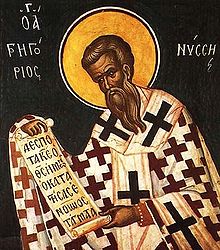
A while back I wrote a short post on how Christians should understand the more difficult passages of the Old Testament. I referred to the patristic exegetic tradition, but did not provide any clear examples or references. For that reason, I thought I should post this short passage from St. Gregory of Nyssa's Life of Moses, which is a perfect illustration of what I was trying to express in that post:

Let us proceed to what follows in the text. We have learned through the things examined already that Moses (and he who exalts himself by virtue in keeping with his example), when his soul had been empowered through long application and high and lofty life, and through the illumination which came from above, considered it a loss not to lead his countrymen to the life of freedom. 
When he came to them, he implanted in them a more intense desire for freedom by holding out worse sufferings to them. Intending to remove his countrymen from evil, he brought death upon all the firstborn of Egypt. By doing this he laid down for us the principle that it is necessary to destroy utterly the first birth of evil. It is impossible to flee the Egyptian life in any other way. 
It does not seem good to me to pass this interpretation by without further contemplation. How would a concept worthy of God be preserved in the description of what happened if one looked only to the history? The Egyptian acts unjustly, and in his place is punished his newborn child, who in his infancy cannot discern what is good and what is not. His life has no experience of evil, for infancy is not capable of passion. He does not know to distinguish between his right hand and his left. The infant lifts his eye only to his mother's nipple, and tears are the sole perceptible signs of his sadness. And if he obtains anything which his nature desires, he signifies his pleasure by smiling. If such a one now pays the penalty of his father's wickedness, where is justice? Where is piety? Where is holiness? Where is Ezekiel, who cries, "The man who has sinned is the man who must die" and "A son is not to suffer for the sins of his father" (Ez. 18:20)? How can the history so contradict reason? 
Therefore, as we look for the true spiritual meaning, seeking to determine whether the events took place typologically, we should be prepared to believe that the lawgiver has taught through the things said. The teaching is this: when through virtue one comes to grips with any evil, he must completely destroy the first beginnings of evil. 
For when he slays the beginning, he destroys at the same time what follows after it. The Lord teaches us the same thing in the Gospel, all but explicitly calling on us to kill the firstborn of the Egyptian evils when he commands us to abolish lust and anger and to have no more fear of the stain of adultery or the guilt of murder. Neither of these things would develop of itself, but anger produces murder and lust produces adultery. 
Since the producer of evil gives birth to lust before adultery and anger before murder, in destroying the firstborn he certainly kills along with it the offspring which follows. Take for an example a snake: when one crushes his head, he kills the rest of the body at the same time. 
This would not have happened unless the blood which turns aside the destroyer had been poured out on our doors. And if it is necessary to perceive the meaning presented here more fully, the history provides this perception in both the killing of the firstborn and the safeguarding of the entrance by blood. In the one the first impulse to evil is destroyed, and in the other the first entrance of evil into us is turned away by the true Lamb. For when the destroyer has come inside, we do not drive him out by our own devices, but by the Law we throw up a defence to keep him from gaining a foothold among us. 
Safety and security consists in marking the upper doorpost and the side posts of the entrance with the blood of the lamb. While in this way Scripture gives us through figures a scientific understanding of the nature of the soul, profane learning also places it before the mind, dividing the soul into the rational, the appetitive, and the spirited. Of these parts we are told that the spirit and the appetite are placed below, supporting on each side the intellectual part of the soul, while the rational aspect is joined to both so as to keep them together and to be held up by them, being trained for courage by the spirit and elevated to the participation in the Good by the appetite. 
As long, therefore, as the soul is kept safe in this manner, maintaining its firmness by virtuous thoughts as if by bolts, all the parts cooperate with one another for good. The rational for its part furnishes safety to its supports and in its turn receives from them an equal benefit. 
But if this arrangement should be upset and the upper become the lower - so that if the rational falls from above, the appetitive and spirited disposition makes it the part trampled upon - then the destroyer slips inside. No opposition from the blood resists his entrance; that is to say, faith in Christ does not ally itself with those of such a disposition. 
For he says first to anoint the upper doorpost with blood, then to touch both side doorposts in the same way. How therefore would one anoint the upper first unless it be found on top? 
Do not be surprised at all if both things - the death of the firstborn and the pouring out of the blood - did not happen to the Israelites and on that account reject the contemplation which we have proposed concerning the destruction of evil as if it were a fabrication without any truth. For now in the difference of the names, Israelite and Egyptian, we perceive the difference between virtue and evil. Since the spiritual meaning proposes that we perceive the Israelite as virtuous, we should not reasonably require the firstfruits of virtue's offspring to be destroyed, but rather those whose destruction is more advantageous than their cultivation. 
Consequently we have been taught by God that we must destroy the firstfruits of the Egyptian children so that evil, in being destroyed as its beginning, might come to an end. And this insight agrees with the history, for the protection of the Israelite children took place through the pouring out of blood in order that good might come to maturity. But what would come to maturity in the Egyptian people was destroyed before it matured in evil.

Life of Moses (Book 2), New York: Harper Collins, 2006, p.56-59.

Thursday, 6 June 2013

Repentance and Confession

by St. Cyril of Jerusalem
(Second Catechetical Lecture)

  1. Sin is a fearful thing, and unrighteousness is the sorest ailment of the soul, secretly sapping its sinews, and exposing it to eternal fire; a self-chosen evil, the offspring of a man’s set purpose of mind. For that of our own purpose we sin, the Prophet says plainly in one place. I planted thee a noble vine, wholly a right seed: how then art thou turned into the degenerate plant of a strange vine unto Me?[1] The planting is good, the fruit is evil: and that evil is from our purpose of mind. The planter is blameless, but the vine shall be burnt with fire: for it was planted for good, yet hath of its own purpose borne fruit to evil. For God, according to the Preacher, hath made man upright; but they have sought out many inventions.[2] And the Apostle says, We are His workmanship, created unto good works.[3] The Creator then, being good, created for good works: but the creature, of its own set purpose, turned to wickedness. Sin, then, is a fearful evil, as was said, but not an incurable one; fearful to him who clings to it, but quite admitting of a cure when a man through penitence puts it off. For suppose a man holding fire in his hand: while he holds the live coal, he is certainly on fire; but were he to put it away, he would also rid himself of that which was burning him. And if any think that while sinning, he is not on fire, to him saith the Scripture, Can a man take fire in his bosom, and his clothes not be burned?[4] For sin burns the sinews of the soul. 

  2. But some will say, What can sin be? Is it a living thing – an angel – an evil spirit? What is this which works in us? It is no foe from without, O man, wrestling against thee: but a shoot of evil taking its increase from thyself. Let thine eyes look right on,[5] and lust does not exist; keep thine own, and take not another’s, and a stop is put to robbery; remember the Judgement, and neither fornication nor adultery, nor murder, nor any unrighteousness shall prevail in thee. But when thou forgettest God, forthwith thou beginnest to devise wickedness, and to accomplish unrighteousness.

  3. However, nature is not the sole cause of evil; there is another, who miserably prompts to it, the devil. He prompts all, yet he prevails only over those who listen to him. Therefore saith the Preacher, If a spirit of the powerful rise up against thee, leave not thy place.[6] Shut thy door, and keep him far from thee, and he shall not hurt thee. But if thou indulgently admit the thought of lust, through thine imaginations, it will strike its roots into thee, and enthral thy mind, and drag thee down into a pit of evils. But perhaps thou sayest, I am a Believer; lust does not gain ascendant over me, even though my mind dwells on the objects of it: knowest thou not that  even a rock is cleft at length by a root which for a long while adheres to it? Admit not the seed, for it will break in pieces thy faith: root out the mischief, ere it blossom, lest by being idle at the beginning, thou have the trouble of axes and fire afterwards. When thine eyes first ail, attend to them in time, lest after thou art blinded thou begin to seek the physician.

  4. The devil then is the chief author of sin, and the parent of evils; and this hath the Lord said, not I: The devil sinneth from the beginning;[7] before him sinned no one. But he sinned not as having received by necessity of nature the principle of sin; (else the blame of sin returns to Him who thus framed him;) but having been framed good, he became a devil from his own purpose of mind, and received his name from his conduct. For being an Archangel, he was called devil, or slanderer, from his slandering; and from a good servant of God, he became Satan fitly so named; for Satan means an Adversary. These doctrines are not mine, but the inspired prophet Ezekiel’s. For he, taking up a lamentation against him, says, Thou sealest up the sun, full of wisdom, and perfect in beauty, thou hast been in Eden, the garden of God; and soon after, Thou wast perfect in thy ways, from the day that thou wast created, till iniquity was found in thee.[8] Very rightly hath he said, was found in thee: for it was not brought in from without, but thou thyself didst beget evil. And the reason he assigns afterwards: thine heart was lifted up, because of thy beauty; I will cast thee as profane out of the mountain of God, I will cast thee to the ground. Parallel to this, is what the Lord says in the Gospel, I beheld Satan as lightning fallen from heaven. Thou seest the harmony of the Old Testament with the New. He, on his falling, drew many away from him. He puts lust into those who listen to him: from him is adultery, fornication, and all evil: through him our forefather Adam was cast out, and exchanged a paradise of wonderful and spontaneous fruits, for this earth with its thorns and thistles.

  5. What then? some one will say. We have been seduced and are lost; is there no chance of salvation? We have fallen; cannot we rise? We have been blinded; cannot we recover our sight? We have been crippled; cannot our feet become straight again? In a word, we are dead; is there no resurrection? Shall not He, O man, who woke Lazarus, a corpse of four days, which stank, shall not He much more easily raise up thee, a living man? He who shed His precious blood for us, the same shall rescue us from sin. Let us not give sentence against ourselves, brethren; let us not abandon our case as hopeless: not to believe there is hope in penitence, is dreadful indeed. For he who is without expectation of salvation, spares not to increase the evil; but he who hopes for a cure, is easily induced to spare himself. Thus the robber who expects no mercy runs into recklessness; but if he hopes for pardon, often betakes himself to repentance. Nay does the serpent strip himself of old age, and shall not we cast the slough of wickedness? Does thorny ground by good tillage become fruitful, and is salvation to us irrecoverable? Nature then admits of salvation; all that is wanting is the purpose of mind.

  6. God is loving to man, and that not a little. For say not, ”I have committed whoredom and adultery: fearful things have been done by me, nor once only but often; will He forgive, will He forget?” Hear what the Psalmist says; O how plentiful is Thy goodness, O Lord.[9] Thy accumulated sins surpass not the multitude of the mercies of God; thy wounds baffle not the skill of the chief Physician. Only give thyself to Him in faith: tell the Physician thine ailment; say thou also as David did; I said, I will confess my sins unto the Lord: and what he says next shall also be fulfilled in thee; And so Thou forgavest the wickedness of my sin.

  7. Wouldest thou see the loving-kindness of God, O thou that art lately come to the Catechising? wouldest thou see the loving-kindness of God, and the abundance of His longsuffering? Hear thou concerning Adam. Adam disobeyed, the first whom God created; might He not at once have visited him with death? But see what the Lord does, in His great love towards man: though He casts him out of the Paradise, the sin making him unfit to continue there, yet He places him opposite to Paradise,[10] that seeing that he had forfeited, and what a downfall he had suffered, he thenceforth might be saved by repentance. Cain, the first born man, became a fratricide, a deviser of evils, the cause of murders, and the first who envied; yet when he had slain his brother, to what was he doomed? a fugitive and a vagabond shat thou be in the earth.[11] How great the sin, how light the doom!

  8. This then in very deed is loving-kindness in God, yet it is small compared with what follows: for consider, I pray, the history of Noah. The giants sinned, and lawlessness was there lavishly poured out upon the earth; and in consequence the deluge was ordained to come upon it. In his five hundredth year God puts forth the threat, and in his six hundredth He brought the deluge on the earth. Seest thou the breadth of God’s loving-kindness, extending over the space of a hundred years? what He did then after the hundred years, could He not have done at once? but on purpose did He extend it, to give room for repentance. Seest thou the goodness of God? And had those men repented, they would not have come short of His loving-kindness.

  9. Let us proceed to others, who have been saved by repentance. Perchance some among the women will say, “I have committed whoredom and adultery, I have defiled my body with excesses; is there salvation?” Cast thine eyes, O woman, to Rahab, and do thou also expect salvation; for if she who openly and publicly committed whoredom was saved through repentance, shall not she, who has committed one such act before the gift of grace, be saved through penitence and by fastings? For enquire how she was saved: this only said she, The Lord your God, He is God in heaven above, and in earth beneath.[12] Your God, for she dared not call Him her own, on account of her unchastity. And if thou wouldest receive a written witness that she was saved, thou hast it recorded in the Psalms, I will think upon Rahab and Babylon with them that know me.[13] Oh the great loving-mercy of God, which makes mention even of harlots in the Scriptures: and not simply I will think upon Rahab and Babylon, but with this added, with them that know me. On men therefore, and likewise on women, is salvation, viz. that which is secured to us through repentance. 

  10. And though the people sin as one body, it does not surpass God’s loving-kindness. The people made a calf, yet did not God give over His love-kindness. Men denied God, but God denied not Himself. These are thy gods, O Israel,[14] they said; yet again, as was His wont, The God of Israel became their Saviour.[15] And not only did the people sin, but Aaron too the high-priest. For it is Moses who says, And upon Adam came the wrath of the Lord; and I entreated, he says, for him,[16] and God forgave Him. What then? Did Moses, entreating for a high-priest who had sinned, prevail with the Lord, and does not Jesus, the Only-begotten, when He entreats for us, prevail with God? And did He admit Aaron, in spite of his fall, to the high-priesthood, and will He obstruct thy entrance to salvation who art come from the Gentiles? Repent, O man, henceforth thyself, and the gift shall not be withheld thee. Present thy conduct unrebukable before Him henceforward: for God is in very truth loving to man, nor can the whole race of man worthily tell out His loving-kindness. No, not if all the tongues of men were to come together, could they even thus unfold some part of His loving-kindness. For we declare some part of what is written concerning His loving-kindness to men: but we know not how much He forgave to Angels: for them also did He forgive, since One only is sinless, Jesus, who purgeth our sins; - but of these enough.

  11. If thou wilt, I will set before thee additional precedents respecting our state. Let us come to the blessed David, and take him for an ensample of repentance. He fell, that highly gifted man. Walking in the evening-tide on the house-top after his sleep, he looked unguardedly, and was moved by human passion. His sin was completed; but in it perished not that nobleness of mind which confesses a transgression. Nathan the prophet came, swiftly, to detect and to heal his wound. The Lord is wroth, he says, and thou hast sinned.[17] So spoke the subject to him who had the kingdom; yet the king, though in purple clad, did not take it ill, as regarding not the speaker, but Him that sent him. He was not blinded by the military circle which stood about him; for his mind discerned the Lord’s angelical host, and as seeing the Invisible, he submitted in the anguish, replying to his visitor, or rather through him to Him who sent him, I have sinned against the Lord. Thou seest how a king could be humble-minded, how he could make confession. Had it been brought home to him by any one? Were many privy to the matter? The matter was done quickly, and forthwith the Prophet came an accuser, and the sinner acknowledges the crime. And according to the frankness of his confession was the speed of his cure, for the prophet Nathan who had threatened him, says straightway, And the Lord hath put away thy sin. Thou seest how very quick was the relenting of the God of loving-kindness. Yet he says, Thou hast given great occasion to the enemies of the Lord to blaspheme. For though on account of thy righteousness thou hadst many foes, yet thy self-command was thy protection; but now that thou has let go thy best weapon, thy foes, who were standing ready, are risen up against thee. The Prophet then thus comforted him.

  12. But holy David, for all he heard it said, The Lord hath put away thy sin, shrunk not from penitence, king though he was: but put on sackcloth for purple, and for his gilded throne sat down, a king, in ashes on the ground; not only sat but fed on ashes, (as he saith himself, I have eaten ashes as it were bread,[18]) and wasted with tears his lustful eye. Every nigh, he says, wash I my bed and water my couch with my tears.[19] When his lords urged him to eat bread, he would not: for seven whole days he prolonged his fast. If a king thus made confession, oughtest not thou a private man to make confession? And after Absalom’s rebellion, though he had many roads for escaping, he chose to flee by the Mount of Olives, all but invoking mentally the Redeemer who should thence ascend to heaven. And when Shimei cursed him bitterly, he said, Let him alone; for he knew that he who forgiveth, shall be forgiven.[20]

  13. Thou seest how excellent it is to confess; thou seest that to the penitent there is salvation. Solmon also fell; but what saith he? Afterwards I repented.[21] Though Ahab, king of Samaria, was a most abandoned idolater, a monster, the murderer of prophets, a stranger to godliness, the coveter of other men’s fields and vineyards, yet when the prophet Elias came to him after he had slain Naboth through Jezebel, and only threatened him, he rent his clothes and put on sackcloth; and what says the merciful God to Elias? Seest thou how Ahab humbleth himself before Me?[22] as if, almost, He would persuade the fiery temper of the prophet to condescend to the penitent: for I will not bring, He saith, the evil in his days. Thus, though Ahab on his pardon was not about to leave his evil courses, the God of pardon pardoned him; - not as ignorant of the future, but bestowing on the penitence of the moment its corresponding pardon: for a just judge suitably answers each case as it arises.

  14. Again, as Jerobam stood sacrificing to idols on the altar, his hand withered, when he bade seize the Prophet who denounced him. On this experience of his power, he says, Entreat the face of the Lord thy God;[23] and for this word his band was restored. If the Prophet healed Jerobam, was not Christ healing power to deliver thee from thy sins? Manasses, again, was most extravagant in his crimes, who sawed asunder Esias, and was polluted with idolatries of every kind, and filled Jerusalem with innocent blood: yet, when he was led captive to Babylon, he converted his afflictions into a healing course of penitence: for Scripture says, that Manasses humbled himself greatly before the God of his fathers, and prayed to Him; and He was entreated of him, and heard his supplications, and brought him again into his kingdom. If he who sawed a Prophet in sunder, was saved through penitence, mayest thou be saved, who hast not done ought so great.

  15. Beware lest thou rashly mistrust its power; wouldest thou know how great force it hath? wouldest thou know this strong weapon of salvation, and learn what strength Confession hath? An hundred and eighty-five thousand enemies did Hezekias turn to flight through Confession. Yet great as this really is, it is but trifling compared with what is still to be told. Through repentance, the same king recalled a Divine decree which had already gone forth. For when he was sick, Esaias said to him, Set thy house now in order; for thou shalt die, and not live.[24] What was there to expect more? what remaining hope of life, when the Prophet said, For thou shalt die? Yet Ezekias did not stop from penitence; for remembering what was written, For turning away and sighing thou shalt be saved,[25] he turned away to the wall, and lifting his thoughts from his bed heavenwards, (for no thickness of walls hinder prayers devoutly offered up,) he said, “Lord, remember me: for it is sufficient for my cure that Thou remember me: Thou art not controlled by times, but Thou Thyself givest law to life; for not on our nativity, and on stars in conjunction, depends our life, as some idly talk; but of life and its duration Thou Thyself art the Lawgiver, according to Thy will.” And thus he, who through the Prophet’s sentence despaired of life, received and addition of fifteen years, the sun, in sign of it, tracing his course back. Now the sun turned back for Ezekias; for Christ, it was eclipsed; not retracing his steps, but suffering eclipse, and thereby shewing the difference of the two, Ezekias and Jesus. Ezekias prevailed to the cancelling of a sentence of God; and will not Jesus vouchsafe His free gift, the forgiveness of sins? Turn away, and bewail thyself, shut to thy door, and pray Him to forgive thee, and remove from around thee the burning fires; for Confession has strength to quench even fire; has strength to tame even lions.

  16. But if thou disbelieve, consider what befell Hananiah and the rest. What fountains did they open? How many waterpots had quenched a flame, which rose to forty-nine cubits? But wherever the flame, exceeded ever so little, there faith gushed out like a river, and there they uttered a spell against their sufferings, saying, Just art Thou, O Lord, over all things which thou hast done towards us: for we have sinned, and broke Thy commandments.[26] And penitence destroyed the flames. If thou disbelieve that it can quench the fire of hell, learn it from the history of Hananiah. But some quick hearer will say, “Them God rescued justly; because they would not commit idolatry, God gave them this power.” Since this has been suggested, I will proceed to one more example of penitence.

  17. What thinkest thou of Nebuchadonosor? Hast thou not heard from the Scriptures that he was bloodthirsty, savage, having a lion’s mind? hast thou not heard how he disinterred the bones of the kings? how he led the people into captivity? how he blinded the eyes of the reigning prince, first giving him to see the slaughter of his children? Hast thou not heard that he broke to pieces the cherubim, not the invisible – no, suppose it not, O man – but the carved cherubim; and that mercy-seat, from which God used to speak audibly? Nebuchadonosor trampled down the veil of holiness: he carried off the censer to a temple of idols; he seized on all the offerings; and burned down the Temple to its foundations? What multiplied punishment did he deserve for slaying kings, setting fire to holy things, leading captive the chosen people, and placing the sacred vessels within idol temples? Was he not worthy of ten thousand deaths?

  18. Such was the greatest of his evil deeds; now turn to the loving-kindness of God. He was turned into a wild beast;[27] he abode in the wilderness, he was scourged that he might be saved. He had claws like a lion, for he made the saints his prey; he had a lion’s mane, for he was a ramping and a roaring lion.[28] He ate grass as an ox; for he was as cattle not knowing Him who had given him the kingdom. His body was bathed with the dew, because he had already seen the fire quenched by dew, and believed not. And what happened? After these things, he saith, I Nebuchadnezzar lifted up mine eyes unto heaven, and I blessed the Most High, and I praised and honoured Him that liveth for ever.[29] When, therefore, he perceived the Most High, and offered up sounds of thanksgiving to God, and came to feel grief for what he had done, and learnt his own weakness, then God restored to him the honour of the kingdom.

  19. What then? Hath He given Nebuchadnosor, after such acts, pardon and the kingdom, on his confession, and shall He not give to thee on repenting the forgiveness of sins, and the kingdom of heaven, if thy life be in accordance? The Lord is loving to men, and swift to pardon, slow to vengeance; let no one then despair of his own salvation. Peter, the chiefest and first of the Apostles, before a little maid thrice denied the Lord; but when remorse touched him he wept bitterly; and to weep shews a heartfelt penitence. Wherefore, not only received he forgiveness for the denial, but was spared his Apostolic dignity.

  20. Having then, brethren, many ensamples of men who have sinned, and repented, and been saved, do yet also heartily make your confession to the Lord: that ye may both receive the pardon of your past sins, and be counted worthy of the heavenly gift, and inherit the heavenly kingdom with all the Saints in Christ Jesus; to whom is the glory for ever and ever. Amen.


[1] Jer. 2:21, [2] Eccles. 7:29, [3] Eph. 2:10, [4] Prov. 6:27, [5] Prov. 4:25, [6] Eccles. 10:4, [7] 1 John 3:8, [8] Ez. 28:12-17, [9] Ps. 31:20, [10] Gen 3:24, [11] Gen. 4:12, [12] Josh. 2:11, [13] Ps. 87:4, [14] Exod. 32:4, [15] Is. 63:8, [16] Deut. 9:20, [17] 2 Sam. 12, [18] Ps. 102:10, [19] Ps. 7:7, [20] 2 Sam. 16:10-11, [21] Prov. 24:32, [22] 1 Kings 21:29, [23] 1 Kings 13:6, [24] 2 Kings 20:1, [25] Isa. 30:15, [26] Dan. 1:6-7, [27] Dan. 4, [28] Ps. 22:13, [29] Dan. 4:32.

Saturday, 25 May 2013

Sermon on the Paralytic


A sermon of our Blessed Father, Cyril, Bishop of
Jerusalem, on the Paralytic at the Pool.
 
(1) Wherever Jesus appears, there is salvation. If He sees a revenue officer sitting in his office, He makes him an apostle and evangelist. Laid in the grave, He raises the dead to life. He bestows sight on the blind, hearing on the deaf. When, as now, He visits the public baths, it is not out of interest in the architecture, but to heal the sick. 
(2) By the Sheep Market in Jerusalem there used to be a pool with five colonnades, four of which enclosed the pool, while the fifth spanned it midway. Here large numbers of sick would lie (unbelief also was rise among the Jews). The physician and healer of both souls and bodies showed fairness in choosing this chronic sufferer to be the first recipient of His gift, that he might the earlier be released from his pains. For not for one day only, nor for two, had the poor man lain on his bed of sickness – nor was it now the first month, no, nor the first year – but for eight-and-thirty years. His long-standing illness, rendering him a figure familiar to passers by, now made him ocular evidence of the power of his healer. For the paralytic was known to all by reason of the length of time. But though the master physician gave proof of His skill, He was rebuffed by those who put an unfavourable construction on His work of mercy. 
(3) As He walked round the pool, “He saw.” He did not elicit the information by asking questions, for His divine power obviated any such need. Not “asking,” but “seeing” how long the invalid had lain there; “seeing,” He knew; indeed He knew before He saw. For if in the case of secrets of the heart “He had no need to question anyone concerning man, for He Himself knew what was in man,” much more was this the case when it was a question of diagnosing diseases with visible symptoms. 
(4) He saw a bedridden man weighed down by a sore sickness; for the paralytic’s heavy load of sins aggravated the long-drawn agony of the disease. A question addressed to the sufferer hinted to him his need: “Wilt thou be healed?” Not a word more; He left him with the question half spoken. For the question was ambiguous; it was because he was sick not only in body but also in soul (compare His later saying: “Behold, thou art cured; sin no more, lest something worse befall thee”) that He asked him: “Do you want to be healed?” What mighty power that implied in the physician, making relief depend only on the patient’s willing! It is because salvation is from faith that He asked “Do you want to be healed?” that his “Yes” might give Jesus His cue. This “Wilt thou?” is the word of Jesus only; it belongs not to doctors who heal the body. For those who treat bodily ailments cannot say to any and every patient: “Wilt thou be healed?” But Jesus grants the will, accepts the faith, and freely bestows the gift. 
(5) Once when the Saviour was passing by, two blind men were sitting by the roadside. Though their bodily eyes were sightless, their minds were open to the light. The blind men pointed out Him whom the Scribes did not recognise. For the Pharisees who, for all that they had been taught the Law – yes, had studied it from childhood to old age – had nevertheless grown old still uncomprehending, now said: “As for this man, we do not know where he comes from” (for “he came unto his own, and his own received him not”). But the blind men kept on crying out: “Son of David, have mercy on us.” Those whose eyes did not serve them to read knew Him whom the students of the Law failed to recognise. 
Going up to them, the Saviour said: “Do you believe that I can do this for you?” and “What will you have me do for you?” He did not say: “What will you have me say to you?” but “What will you have me do for you?” For He was a doer, a maker – a giver of life, too – not now beginning to do for the first time (for His Father works always, and He works with His Father); He was the maker of the whole world at His Father’s command. Alone begotten, without intermediary, of the Alone, He questions the blind men, saying: “What will you have me do for you?” Not that He did not know what they wanted, for it was obvious: but he chose to make His gift depend on their answer, that they might be justified out of their own mouths. The reader of hearts could not be ignorant what they would say; but He waited upon their words; now His question was their cue. 
(6) He stood by the cripple, the doctor visited the sick man, nor is it so strange that He condescended to attend the invalid by the pool, for had He not visited us from Heaven? He asked him: “Wilt thou be healed?” by the question leading him on towards the saving knowledge, raising a question in his mind. A gift, truly, of grace! No fee was charged; else the patient would not have had the physician coming to him. He said to Him: “Yes, sir; for the long duration of my illness makes me desire health; but, desire it as I may, I have no man…” Do not lose heart, my good fellow, because you “have no man”; God you have standing by you, One who is at once man and God under different aspects; for both must be confessed. The confession of the humanity without the confession of the divinity is unavailing, or rather earns a curse. For “cursed is he who puts his trust in man.” So with us: if, hoping in Jesus, we hope in the man only, not including the divinity, we inherit the curse. But as it is, we confess both God and man, and both truly: in worshipping Him as God truly begotten of the true Father and as man not merely in appearance, but really and truly born, we receive a real and true salvation. 
(7) “Yes, I do want to be healed, but I have no man…” Maybe it was because of his dire straits that Jesus came to his rescue. For the generality of the sick had relatives, friends too, and maybe other helpers. But the poor cripple, crushed by a literally universal want, utterly destitute, abandoned, alone, found the Son of God, the Only-begotten, coming to his aid. 
“Wilt thou be healed?” “Yes, Lord, but I have no man, when the water is troubled, to put me into the pool.” No, but you have the spring itself. “For with thee is the fountain of life,” the fountainhead of all fountains. “He who drinks of this water, out of his belly shall flow rivers,” not of the water that flows downwards but of that water that springs up – for the spring inspired by Jesus’ draught, unlike man’s puny leap which lands him back on earth again, carries us up to the sky; the water “bubbles up unto life everlasting.” Jesus is the wellspring of all blessings. 
(8) Why, then, fix your hope on a pool? You have Him who walks upon the waters, who rebukes the winds, who holds sovereign sway over the ocean; who not only Himself walked on the sea as on a firm pavement but vouchsafed the like power to Peter. For when the night was black and the Light, though it was there, was not recognised (for Jesus, walking on the waters, passed unrecognised in face and features; it was the characteristic timbre of His voice that betrayed His presence), they, thinking they were seeing an apparition, were frightened until Jesus said to them, “I AM, do not be afraid.” Peter said to Him: “If it be Thou whom I know, or rather whom the Father revealed to me, bid me come to Thee over the waters”; and Christ, generously sharing what was His own, said: “Come.” 
(9) There stood by the waters of the pool the Ruler and Maker of the waters. To Him the cripple said: “I have no man, when the water is troubled, to put me into the pool.” The Saviour said to him: “Why do you await the troubling of the water when you can be cured with no trouble at all? Why wait for the movement that is seen? More swiftly is the mind’s command performed by the word. Only look down into the swirling power of the spring and glimpse there God clothed in flesh; consider not the man whom your eyes see, but the invisible God who works through Him whom you see.” 
“I have no man, when the water is troubled, to put me into the pool.” He said to him: “Why set such narrow bounds to hope, intent on some poor water-cure? Arise: He who commands it is the Resurrection.” 
Everywhere the Saviour becomes “all things to all men”; to the hungry, bread; to the thirsty, water; to the dead, resurrection; to the sick, a physician; to sinners, redemption. 
(10) “Rise, take up thy pallet and walk.” But first rise, cast away your sickness; afterwards you can put muscle on faith. Exert your strength first upon the bed that used to carry you; learn to carry away on a wooden stretcher those passions by which you were for so long carried away. He was ordered to carry his wooden litter by that Saviour of whom it was said: “The King hath made him a litter of the wood of Lebanon. The pillars thereof he made of silver, the seat of purple, the inside paved with mosaic.” The imagery represents the Passion, this imagery reserved in the Song of Songs for sober and chaste bridals. 
For you must not, accepting the vulgar, superficial interpretation of the words, suppose that the Canticle is an expression of carnal, sexual love. No; it is the language of bridals with an immortal Lover, bridals pure and chaste. If you do not divine the sense of the Canticle, go to the book of Proverbs. Make an indirect approach, mounting by degrees to the Canticle. “Wisdom hath built herself a house,” it says, as though speaking of a woman, “and hath sent her servants.” Elsewhere it says: “Love her, and she will protect thee.” This is not the love of woman, but of wisdom, which drives out carnal love. For where wisdom is stored, there carnal love is banished; not passions but wise thoughts house with wisdom. “They are become as stallions frenzied in heat”: an urge unworthy of reason. If, then, in the Canticle you hear talk of a bride and a bridegroom, do not read into such language a reference to sexual passion (that would be to fall back to earth), but sublimate the passions by the passionless. 
(11) Meditate on the heavenly lessons of the Song, a Song that breathes chastity and tells of the Passion of Christ. In describing the Passion of the Saviour, it even names the place: “I am come into my garden,” referring to the Garden of His burial. It mentions the spices too: “I seized the aromatic spices in handfuls”; for the divine purpose reached its fulfilment. After His resurrection He said: “I have eaten my bread with my honey.” For “they gave him honey from the honeycomb.” Again, referring to the wine mingled with myrrh, the Canticle says: “I will give thee a cup of spiced wine.” Of the perfume poured over His head it says elsewhere: “While the King was at his repose, my spikenard sent forth the odor thereof”; for “when he was reclining at table in the house of Simon the leper, a woman came in and broke an alabaster box of ointment of precious spikenard, which she poured over His head.” So of the Cross: “…a litter of wood” – the wood of the cross which carried Him – “the pillars thereof he made of silver.” The commencement of the cross was silver, the betrayal. For as a beautiful chamber is crowned with a golden roof, the whole structure soaring upon pillars, so of both the crucifixion and of the resurrection of Christ the beginning was silver. For if Judas had not betrayed Him, He would not have been crucified. Therefore it was, as symbolising the beginning of His famous Passion, “the pillars thereof he made of silver.” 
(12) “The coverings of purple.” Therefore they also “clothed Him in purple”; in mockery, of course, but fulfilling the prophecy; doing it under inspiration, for He was a King. However much they did it in a spirit of derision, still they did it; His royal dignity was emblematically heralded. So, likewise, though it was with thorns they crowned Him, it was still a crown. And it was soldiers who crowned Him; kings are proclaimed by soldiers. “The covering of purple, the inside paved with mosaic”: the devout children of the Church know Lithostrotos or “Gabbatha” in Pilate’s palace. 

(13) But this is a digression; when on the subject of the pallet, I was led on to speak of the litter in the Canticle. 
He said, therefore, to him: “Rise, take up thy pallet and walk.” The disease was long-standing, the remedy swift. The paralysis had lasted for years; the strengthening of the sinews was instantaneous. For the creator of the sinews, He who provided a variety of remedies for the blind, He who gave that incongruous salve by anointing with clay (for a plaster of clay, applied to sound eyes, deprives them of sight, but Jesus by means of clay bestowed sight upon the blind)…His power reached others by yet other means. 
Where He simply said: “Rise, take up thy pallet and walk,” what astonishment, do you think, seized the beholders! Yet, marvellous as the sight was, it was the faithlessness of the onlookers that was really strange. A years-old disease is healed, but an obstinate incredulity was no healed. Instead the Jews’ malady persisted; they did not want a cure. 
(14) If they were right to be amazed by the incident, they should have gone on to adore the healer of bodies and souls. But they murmured; for they were the children of murmurers, of those who twisted good into evil, calling bitter sweet and sweet bitter. It was quite in accordance with the divine “economy” that Jesus worked on the Sabbath, performing deeds transcending the Sabbath, that the deed might convince. It was because an assertion can be met by a counter-assertion, while there is no answer to the deed, that He used to heal on the Sabbath; the lesson is, instead of relying on arguments, which only provoke counterarguments, to let deeds convince the onlookers. 
(15) They said to him: “It is the Sabbath; it is not lawful for thee to take up thy pallet.” The Lawgiver was present, and another says: “It is not lawful for thee?” “Appoint, O Lord, a lawgiver over them”: it was spoken of the Saviour. The man who had just been cured both in soul and body immediately retorts with a wise word from Wisdom. Unable to give a legal answer, he makes a brief one: “You all know,” he says, “my long-standing sickness and the long years I was bedridden, my destitution in my distress. Not one of you ever took pity on me, taking me and putting me first into the pool that I might be cured. Yet, when you showed no pity, how have you now assumed the office of lawgivers, saying: “You’re not allowed to take up your pallet?” My answer, then, in a nutshell is this: ‘I did it at the command of Him who cured me.’ However little account you make of me, yet the deed should impress you. He applied no salve; He employed none of the expedients or remedies known to medicine. He spoke a word, and the work followed; He commanded, and I executed His command. I am only obeying the command of Him who by His command healed me. For if He who commanded had been powerless by His command to cure me, I should not be obliged to obey His commands. But now that His word of command has caused a palpable and inveterate illness to disappear, I have every right to listen to Him to whom my disease listened and, listening, was ended. He who made me well, he it was who said to me: ‘Take up your bed’.” 
(16) The miraculé did not know the identity of his healer. We have here a striking instance of our Saviour’s shunning of vaingloriousness. For after working the cure He turned aside to avoid receiving recognition for the cure. We do just the opposite. If we are fortunate enough to have a vision in a dream or to succour someone by the imposition of hands or to drive out a devil by invoking the Lord, so far are we from hiding our little triumph that, even unprompted, we boast about it. Jesus gives us an object lesson in not talking about oneself. After the cure He immediately turned aside to avoid recognition. He comes and goes as the occasion calls. When it was proper to prevent the acclaim of the achievement, He withdraws; only when the crowds had gone did He reappear to add spiritual to physical healing, saying: “Behold, you are well: sin no more.” 
(17) He is a versatile doctor, sometimes healing the soul first, and then the body, sometimes following the reverse order. “Leave your sinful ways, lest something worse befall you,” He says, through one teaching many. For the warning is addressed not alone to the man in the Gospel, but to all of us. For if ever we find ourselves afflicted by sickness, grief or trouble, let no one lay it to God’s charge: “for God cannot be tempted by evil, and himself tempts no man.” Each of us is scourged, “fast bound with the ropes of his own sins.” 
“Sin no more, lest something worse befall you.” Listen to the saying, Everyman. Let him who before was a fornicator slough off his lust; let him who before was avaricious become generous in almsgiving; let the thief pay heed: “Sin no more.” Great is God’s forbearance, lavish His grace. But let not His exceeding patience breed contempt. Do not make God’s long-suffering a pretext for continuing in sin. Take the cure for your carnal passions, so that you too can say, in the words of the lesson so appropriately read: “For what time we were in the flesh, the sinful passions, which were aroused by the law, were at work in our members.” If the Apostle says, “What time we were in the flesh,” he was not speaking of our mortal envelope of flesh but of the deeds of the flesh. He was himself, indeed, still clad in the flesh when he said, “What time we were in the flesh.” It is in the sense in which, when the deluge was preparing, God said: “My spirit shall not remain in these men, because they are flesh” (the spirit being perverted to fleshly appetite), that the Apostle says: “When we were in the flesh.” 
(18) Let no one, then, be “in the flesh”; but, being in the flesh, let him not walk according to the flesh. The Apostle does not mean that, to avoid sin, we should withdraw altogether from the world, but that, being in the flesh, we should make the flesh our servant and not be ruled by it. Let us not be slaves, but masters, in our own house. Let us be moderate in our eating, not allowing ourselves to be carried away by gluttony. So bridling our appetite, we shall govern also its henchman, lust. Let the soul rule the body and not be at the beck and call of animal instinct. 
“Sin no more, lest something worse befall you.” It is a warning to all; God grants that all ears may hear it. For it is not always that the fleshly ear, when it receives a message, transmits it to the mind. That is why the Saviour, when addressing those who had “ears of flesh,” said, “If you have ears that can hear, then hear.” 
(19) Let everyone, then, give ear to Jesus and “sin no more.” Let us, rather, hasten to the great Pardoner. Are we ill? Let us have recourse to Him. Is it a sickness of the soul that ails us? Let us become disciples of the physician of knowledge. Are we hungry? Let Him give us bread. Are we dead? Let Him raise us to life. Have we grown old in ignorance? Let us beg wisdom of Wisdom. 
(20) But my sermon has betrayed me into wordiness, and I am, maybe, standing in the way of its practical lesson. God grant that all of us may heed the Saviour’s words, that, aided by mightier works, we may send up our praise to God, to whom be the glory now and forever, through all eternity. Amen.
Anthony A. Stephenson (trans.), The Works of Saint Cyril of Jerusalem, vol. 2,
Washington, D.C.: The Catholic University of America Press, 1970, 209-222.

Wednesday, 20 March 2013

The Christian view of the Old Testament

Having now entered the period of Great Lent, in which the daily readings from the Gospels and Epistles are replaced with readings from the Old Testament books of Genesis, Isaiah, and Proverbs, I thought it would be appropriate to post this rather nice quote by Blessed Theodoret, which is found on p.219 of Pomazansky's Orthodox Dogmatic Theology (see previous post):

Just as mothers of just-born infants give nourishment by means of the breast, and then light food, and finally, when they become children or youths, give them solid food, so also the God of all things from time to time has given men a more perfect teaching. But, despite all this, we revere also the Old Testament as a mother's breast, only we do not take milk from there; for the perfect have no need of a mother's milk, although they should revere her because it was from there that they received their upbringing. So we also, although we do not any longer observe the circumcision, the Sabbath, the offering of sacrifices, the sprinklings - nonetheless, we take from the Old Testament a different benefit: for it, in a perfect way, instructs us in piety, in faith in God, in love for neighbour, in continence, in justice, in courage, and above all it presents for imitation the examples of the ancient saints (Blessed Theodoret, Brief Exposition of Divine Dogmas)

Friday, 16 November 2012

On exploitation of the workforce

by St.Nicodemos the Hagiorite

For foremen, sitting idle and doing no work at all, make acquisitions and gains from the toil and sweat of their apprentices and colleagues, whereas those poor and hapless folk who do work remain in deprivation. The proprietors of estates daily exhaust the unfortunate farmhands who work their fields and vineyards, exploiting them inhumanly with interminable and intolerable chores; they use their bodies as though they were irrational animals or, to put it better, insensate rocks; they regard them as bought servants and slaves and behave towards them with greater harshness than did Pharaoh towards the enslaved Hebrews in Egypt,[69] becoming new taskmasters and inhuman tyrants towards those poor folk. And the worst evil that they do to them is this, that after the farmers have threshed the crops and put the wine and the oil into the presses, the owners of the fields come along and, not content with receiving their share of the field and the vineyards, while leaving the rest to the farmers, in addition to this they take from their fruits and take also the interest of the money that they have lent to the farmhands; or else they give them a low price and themselves take all of the fruits. Hence, there remain neither a few crops on the threshing-floor nor a small amount of wine or oil on the presses for the poor labourers to take to their houses to nourish their wives and children. Instead, these hapless men toil for the entire year, working, contending wit the cold of the winter and the heat of the summer, sowing, reaping, threshing, digging, pruning, harvesting, and treading; much later on, the poor wretches return to their homes empty-handed, dejected, grief-stricken, and anguished. Oh, what bestial inhumanity this is! Oh, what greater injustice can there be than this_ How, then, are those unhappy men to govern their households? How are they and their wives to sustain themselves? How are they to console their children when they cry and clamor, groaning from hunger? God be gracious unto us!

For this reason the great Chrysostomos was right to call such proprietors of fields and vineyards more unjust than all other men and harsher than any barbarians, saying:
Who are they? Those who possess fields and reap the wealth that comes from the earth. And what could be more unjust than this? For if one were to examine how they treat their wretched and misearble labourers, he would see them to be more savage than barbarians. For upon those who are wasting away with hunger and toiling throughout their lives they both impose constant and intolerable payments, and lay on them laborious tasks, and they treat their bodies like asses or mules, or rather like stones.[70]
For this reason the same Chrysostomos was right to call the poor labourers who suffer the aforementioned evils more pitiable than all men, saying: "What could be more pitiable than this, when after having toiled throughout the winter, and being worn out from frost and rain and lack of sleep, they depart empty-handed, and even in debt?"[71] For this reason, with every justification, after all of this the same golden John exclaims with perplexity and astonishment that for these evils and injustices that landowners do to their labourers Heaven should shudder and the earth tremble: "Wherefore, it is meet to adduce the Prophet and to say, 'Be astonished, O Heaven, and shudder, O earth.'[72] To what great brutality has the human race been carried away!"[73] And in truth, Heaven ought to shudder and the earth tremble on account of this exceeding wickedness on the part of landowners; for they become murderers, shedding blood and disipating the lives of their poor farmhands. Indeed, they take from them the food that they were going to live on, as the wise Sirach declares:
The bread of the needy is the life of the poor: he that defraudeth him thereof is a man of blood. He that taketh away his neighbour's living slayeth him; and he that defraudeth the labourer of his hire is a blood-shedder. [74]
Again, he says:
My son, defraud not the poor man of his living....Make not an hungry soul sorrowful; neither provoke a man in his distress...Reject not the supplication of the afflicated; neither turn away thy face from a poor man. [75]

Hieromonk Patapios (ed. trans.), On Christian Morality by St. Nicodemos the Hagiorite, Institute for Byzantine and Modern Greek Studies: Belmont, MA 2012pp.242-3

[69] Exodus 1:8-14
[70] "Homily LXI on St. Matthew," §3, Patrologia Graeca, Vol. LVIII, col. 591.
[71] Ibid.
[72] Cf. Jeremiah 2:12
[73] "Homily LXI on St. Matthew," §3, Patrologia Graeca, Vol. LVIII, col. 592.
[74] Ecclesiasticus 34:21-22
[75] Ecclesiasticus 4:1-4